
Much has been made of the Reverend William Herbert Greenland Padfield who was Principal from 1908 to 1932. He has been described as ‘The Renaissance Man’ and several iconic parts of the school such as the 67 steps and the Church were built in his era and are therefore attributed to him. Reality is that he was a colonial servant serving British interests and emphatically, not Indian interests. As well as being the Principal of Lawrence School, Lovedale, he was a Minister of the Church of England and as such was presiding over Protestant religious ceremonies relating to Births Marriages and Deaths throughout the Nilgiris. The following facts will astonish many who are under the impression that they studied in an institution that has a glorious past:
During the Padfield era:
In 1911 The Criminal Tribes Act was passed. This Act enabled our British rulers to classify whole groups as criminals even though neither a member nor the member’s ancestors nor descendants had ever committed a crime in their lives! See Link below:
https://en.wikipedia.org/wiki/Criminal_Tribes_Act
1.3 million Indians volunteered to fight for the British in WW1 which went on until 1918. None of them would have been able to send their offspring to the school.
The Rowlatt Act of 1919 was passed which allowed Indians to be detained indefinitely and without trial.
The Jallianwala Bagh massacre took place also in 1919 in which thousands died. Ironically, the butcher of Jallianwala, General Dyer was not only born in Murree (present day Pakistan) but also attended Lawrence Asylum Murree where many years later Rev Padfield was Principal. Indeed Rev Padfield’s son, William Lawrence Norton Padfield was also born in Murree on 30 January 1905.
When General Dyer was forced to leave India in 1920, the British community of which Rev Padfield was a part, raised £26000 for him, worth in today’s terms £1.15 million!


Ecclesiastical Ceremonies performed by Padfield: Records held for Lovedale show: 119 Births, 28 Marriages (many of these ‘double’ counted as if a couple married each other that would count as 2 records), and 64 deaths. Below are extracts from records.


Most of those born were baptised by Rev. Padfield, and indeed many of those he baptised, he went on to admit to the school. Rev. Padfield solemnised all but one or two marriages and he performed the burial ceremony of most of the deceased. Example:
| Name | DOB | Baptism | Entry to School |
| Emily Jane McGahan | 14 June 1907 | 20 February 1913 | 20 February 1913 |
| Eileen Patricia McGahan | 29 February 1912 | 20 February 1913 | 1 January 1918 |
| Helen Mary Auston | 12 July 1908 | 9 August 1908 | 20 July 1918 |
| Moya Hilda Bone | 26 September 1917 | 18 October 1917 | 15 March 1923 |
| Gladys Eileen Mumford | 21 June 1920 | 12 Sept 1920 | 15 February 1927 |
| Marguerite Edith Mumford | 12 December 1915 | 6 February 1916 | 15 February 1927 |
Attached below is the register showing the last two names baptised by Rev Padfield. What is more important is the name Joan Eda Winifred Eames at the top, born 1 June 1910. Although not baptised by Padfield, I have paid attention to this name because Joan’s father Earnest Henry James Eames is described as Inspector Salt Abkari and Customs. The Salt tax was one of the most egregious imposed by the British on Indians. This tax was being imposed by a community that Padfield was very much part of. See also link below the register showing the extent to which the British went to extract such a tax

The Reverend whose extra-large photograph still adorns Large Hall (previously the church) did not perform any religious ceremony for any Indian, nor were Indians admitted to school either to learn or even teach. No records were held for any Indian servants. To quote Dane Kennedy, author of ‘The Magic Mountains: Hill Stations and the British Raj ‘The Lawrence Asylums offered an education that stressed discipline, obedience, piety, respectability, and acquiescence to a future of limited opportunity. Boys wore artillery uniforms, girls drab jackets and white bonnets, and both were divided into military-style companies that marched on parade grounds. They did not depend on Indian servants; they did most tasks themselves so that they would become “trained in industrial habits.” Lawrence envisioned his wards taking up manual trades like carpentry and smithing, creating the nucleus for a British artisanal class in India. A subsequent Principal, the Rev C B Hall is quoted as saying c.1938: ‘I very much want to provide an Indian padre to devote himself to the moral and spiritual welfare of our Indian servants and their families. At present we can’t afford to do so’ . So the school was all white virtually until the beginning of the 1940s and even then the nearest the school came to be remotely connected with the real India was the admittance of Anglo-Indians. The first Indian admitted was in June 1947.
This is what Glimpses of a Glorious past says: ‘This was the man to whom much of the asylum’s future successes would be attributed to. The man, School Archivist Nitya C. Matthai has called “The Renaissance Man,” who changed the tone and tenor of the school and gave it a military bearing. No one can see the future and in making the choice, the Committee perhaps would not have imagined that the new person at the helm of the asylum’s affairs would lead the institution for the next 24 years. He more than repaid the Committee’s judgement in his selection in that he achieved what most would have thought impossible, shepherding the progress of an asylum which provided shelter, food and a rudimentary education to orphans of British soldiers in India, to attain the status of a “Royal” school. His name: The Rev. William Herbert Greenland Padfield. MA.’
This is utter rubbish! Rev Padfield was a loyal Colonial Servant, part of the ruling elite! Any good he did at Lawrence School was for our Colonial Masters, United Kingdom, emphatically not for Indians who were not allowed into the school notwithstanding that 1.3 million Indians volunteered to fight for the British in WW1. The ‘Royal’ status was for the prestige of the students who studied not for the benefit of Indians but to have the skills to oppress Indians! That is what Colonialism is about!
Make no mistake. The Rev Padfield, had he remained in England, would have been a small time Church Minister on a small stipend and nowhere near being able to enjoy the lifestyle he had in Lovedale. I have been to Fenton House where the Reverend got married and was not impressed! The Headmaster’s house in Lovedale is far more spacious and certainly the gardens/lawn attached to the Lovedale house is vastly superior! It follows that the Reverend was ‘upwardly mobile’ to use modern phraseology which is to say he aspired to better himself financially. At Lovedale, not only did he get a salary that would have been well in excess of anything he would have earned in UK but the money he would have made in his capacity as a Church official ministering to his all-white flock (baptisms, marriages, burials, regular church services and special services such as Easter and Christmas both, within the School community and out) would have made him a wealthy man without having done anything for Indians and India.
The following extract is also shown in my Post: Mrs Fowles and I.
Here is an extract from Glimpses of a Glorious Past written by Prem Rao, who was a year senior to me:
PRESENTATION OF COLOURS
TO THE SCHOOL BY HIS ROYAL HIGHNESS
THE DUKE OF CONNAUGHT AND STATHEARN , K. G.
On Saturday , January 15th, 1921.
The colour party now advanced, the Principal handed the King’s colour to H.R.H. from whom Albert Neale
received it kneeling. The school colour was similarly received by Cyril Neale.
H.R.H. then spoke as follows:-
“ It is a great pleasure to me to present these colours to the Lawrence Memorial School for I well know how close and honourable is the connection that binds you to the British Army.
I congratulate your Principal and your Officers on the distinguished record your school has achieved and on the very smart and workman like appearance of the cadets whom I see before me now. I trust you will look upon these colours as the emblem of your duty to your school and country and I hope that many of those who are henceforth to serve under these colours will live to serve, The King Emperor with honour and distinction in the larger spheres of life.”
The principal mentioned is , of course, The Rev Padfield. Anybody who oversees the handing of the King’s colours, is praised for ‘the close connection that binds you to the British Army’ and then hears the Duke urge all present to serve The King Emperor, is no friend of India!
Below are photos of the ‘famous’ 67 steps and the Church. Neither are of any architectural merit, they just happen to have been built during Padfield’s tenure:


THE PADFIELD LINE
Here is some interesting History about the much revered Reverend written by his grandson Tim:
On 31 July 1902 George Trewby’s eldest daughter, May, married William Herbert Greenland Padfield, graduate of Emmanuel College, Cambridge, and described on the marriage certificate as ‘mathematical tutor in Lucknow [India]’. He came from a West-Country family from Frome, Somerset. The photograph below was taken at their wedding reception with some 200 guests seated before the South front of Fenton House.
In the photographs below, on the left is the actual photo of the wedding reception of the Rev Padfield. The reception was certainly held in the lawns of Fenton House as the interior of the House couldn’t fit is that many people inside. Next to that is Jitu outside Fenton House as it stands today and below is the House the Rev Padfield occupied as Principal. The latter is vastly superior to Fenton House.
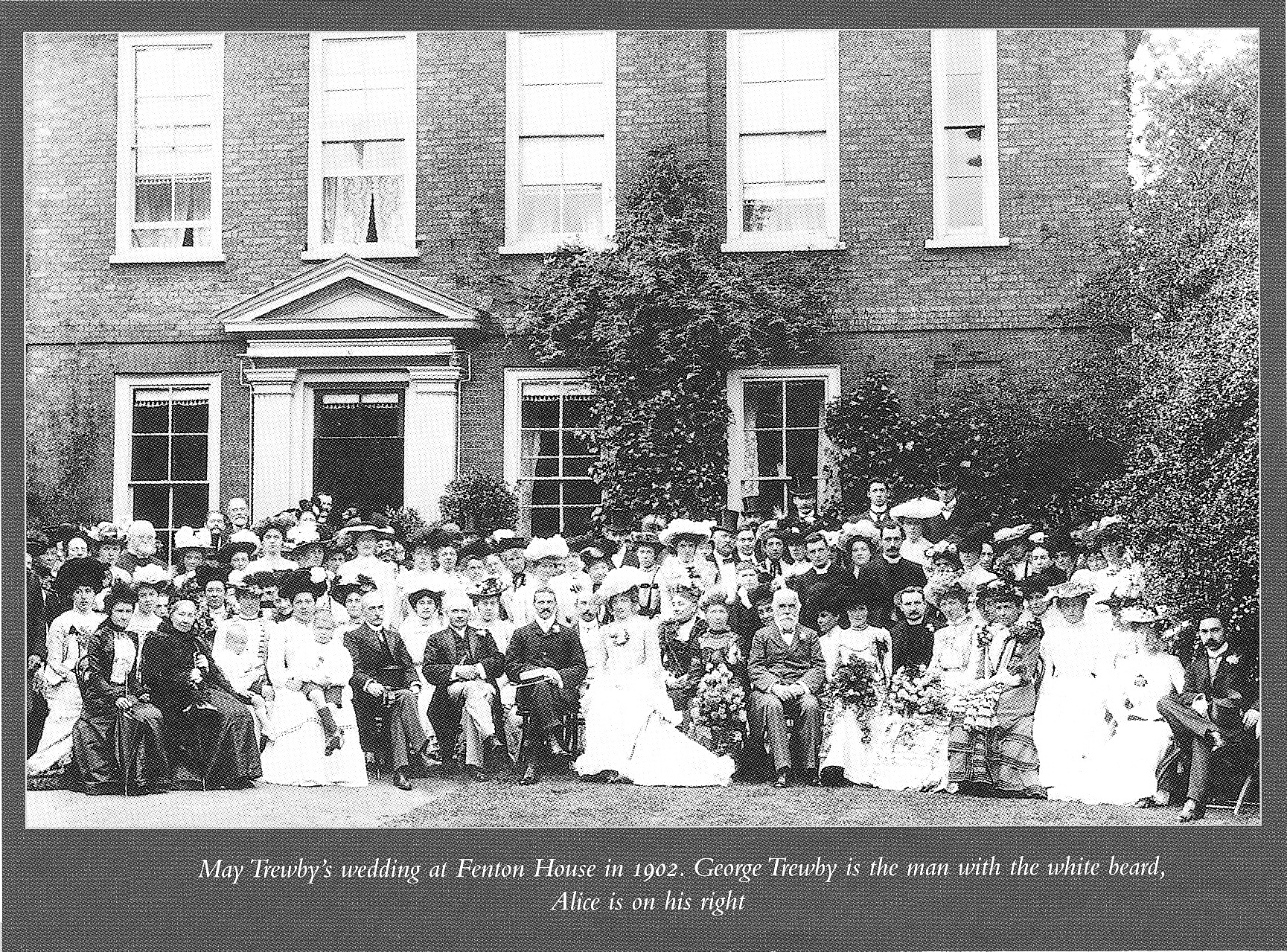


The couple spent most of their married life in India where, from 1908 – 1932 the Rev. William Padfield – as he had become – was Principal of the Lawrence Memorial School, Lovedale, Ootacamund. He is still remembered as the most significant early principal of the school.
Their first son, William Lawrence Norton (‘Bobs’) Padfield – named after the Lawrence School or its founder, General Sir Henry Lawrence – was born in 1905, and was sent ‘home’ to England at age seven. He boarded at Winchester House Preparatory School, Deal, then Marlborough College – some of whose horrors, vividly portrayed by his contemporary John Betjeman’s autobiographical poem, ‘Summoned by Bells’, he later recounted to his elder son. He joined the Royal Engineers, trained at Woolwich and after a year at Selwyn College, Cambridge, departed for India on attachment to the Indian Army. Rising to captain, Royal Engineers, his final work was to prepare the Indian railways for the impending second world war. In 1939 he missed his vaccinations and died of typhoid fever.
His wife, Edna Abbott, took their two sons, Peter Lawrence Norton Padfield and Timothy Donald William Padfield to England by P & O steamship, and lodged with her mother-in-law, May Padfield, at Chineside, Shanklin, Isle of Wight, built by a former Bishop of the Isle of Wight – with a chapel in the garden where the son with birth certificate Donald William Padfield was christened with the additional first name Timothy, to soften the wound of Donald being named after a former boyfriend.
Peter Padfield married Jean Yarwood, daughter of a distinguished engineer and director of George Wimpey Construction.
Timothy Padfield is a research scientist in the conservation of antiquities. He married Frances Ilian, a librarian and teacher. They have one son, Nicolas, who is a laboratory leader at Roskilde University, Denmark. He married Pia Nielsen, a care worker, and they have two children, Olivia and Tobias.
Bill Padfield married Gloria Chavarro. They have no children.
The Rev. Padfield’s younger son, Herbert Geraint Trewby (‘Bertie’) Padfield joined the Royal Navy via Osborne House, Isle of Wight, and the Britannia Royal Naval College. He served at sea throughout the second world war. Bertie reached the rank of captain; his last command was the research cruiser, HMS Cumberland.
Note: The play, ‘The Winslow Boy’ revolves around an incident that took place in Osborne House. This play, put on by Mac (see Pages devoted to him), took his, Mac’s reputation to stratospheric heights in the eyes of his young students. In reality, it was just an ordinary everyday play acted out by school children!
Lois Padfield married Terence (‘Terry’) Driscoll. They have two children, Julia and Richard.
The praise heaped on the Reverend is perhaps misplaced when he, rather like Sir Henry sent his own offspring to elite Public Schools in England.
Always remember that the Jallianwala Bagh massacre happened during the period Padfield was Principal. In view of both, his and Dyer’s connection to Murree where Padfield was Principal and Dyer was a pupil, albeit at completely different times, Padfield should have spoken out but there is no record of even a murmur from him. See below clip giving details of the massacre.
Report by Friend of India Horniman
- Note: Kipling described General Dyer as the man who saved India.
- Captain Amarinder Singh erstwhile Chief Minister of Punjab and grandson of Maharaja Bhupinder Singh of Patiala whose debauched life is the stuff of legends. Bhupinder Singh praised the actions of Dyer and kept his friendship with Dyer’s boss General O’Dwyer, Governor of Punjab at the time of the massacre. Bhupinder Singh Meets General O’Dwyer in London c. 1930.
- Sukhbir Singh Badal a Senior Politician in Punjab. This character donated £100k to Lawrence School Sanawar which is not in Punjab, from the Government of Punjab!
Below are images of Freedom Fighters Hanged while Padfield was Principal


In summary, Padfield was just another Colonial servant loyal to Britain’s King; never to ordinary Indians!
Here is an irony: Watch this clip of a run of the mill British News Anchor, Patrick Christys, demanding that India hands back aid given on the basis as India had no right to send Chandrayan to the moon! Christys is Greek on his father’s side and Irish on his mother’s side. Thousands of Indians laid down their lives liberating Europeans, including Greeks who folded early and without a fight, and as for the Irish, their leader Eamon De Valera sided with Hitler!