Please also see Page Indians Who Fought For The British Empire
Both of the Lawrence Schools, Sanawar and Lovedale despite their obtaining Royal Military status played no part whatsoever in enabling INDIAN personnel to achieve military rank of any sort as Indians were simply not allowed into the institutions. So why the elaborate Military style parades year after year wasting valuable resources honouring the Founder. Why the legendary status accorded to Principal Padfield who joined the school in 1908 and remained until 1932. The first Indian Officer to obtain status as a King’s Commissioned Officer came about only in 1917 and even then, reluctantly! On the other hand pupils from Lovedale used to be sent to Chepstow, Wales to enrol into the British Army and any ‘officer’ produced there would outrank the highest Indian Officer.
In the above link there is an analysis of the hierarchy of Indian Army personnel and their British Army equivalents. However, care should be taken when comparing Viceroy’s Commissioned Officers (jemadar and above), with their British counterparts (who held their commission from the British Crown) as even the most senior VCO (Viceroy’s Commissioned Officer) was subordinate to the lowest ranked British officer.
King’s Commissioned Indian Officer
The above link shows just how difficult it was for Indian Army personnel to get a King’s Commission into Indian Army. Little wonder that even after Independence, the Indian Army continued to be run by British Officers. The first Commander-in-Chief of the Indian Army in INDEPENDENT India was General Rob Lochart. He was succeeded by British General Roy Bucher (1 January 1948 and 15 January 1949). he served as the Commander-in-Chief, Indian Army).
At the same time the Pakistan Army had an equivalent, also a British Officer, called General Frank Messervy. Here is an extract from Wikipedia about this character:
‘On 20 August, a letter signed by Messervy went out to all the brigade headquarters in northwest Pakistan, attaching plans for a certain Operation Gulmarg. According to the plan, 20 lashkars of Pashtun tribesmen were to be armed and trained in various brigade locations in northwest Pakistan for an armed invasion of Kashmir. The information leaked out, one of the letters having fallen into the hands of an Indian officer Major Onkar Singh Kalkat. Kalkat was put under house arrest, but he escaped and made his way to India. By the D-day of 22 October, when the attack was launched, Messervy was away in London, leaving General Douglas Gracey, the Chief of General Staff, as the Acting Commander-in-Chief. On his return, he stopped in Delhi, where Lord Mountbatten made him swear that he had not been asked for, nor had he provided, any help to the tribesmen. But within a week he was found providing arms and ammunition to the Pakistani invading forces. He complained to Governor George Cunningham of the NWFP that Mountbatten had gone over to the side of the “Hindus”.’
The point is that both India and Pakistan had British Generals calling the shots, playing one off against the other. it is inconceivable that the two Britishers were not colluding with each other. There is even talk about the Britishers talking to each other in French so that any Indians eavesdropping wouldn’t understand.
This was the start of the Kashmir crisis and India is still paying the price!
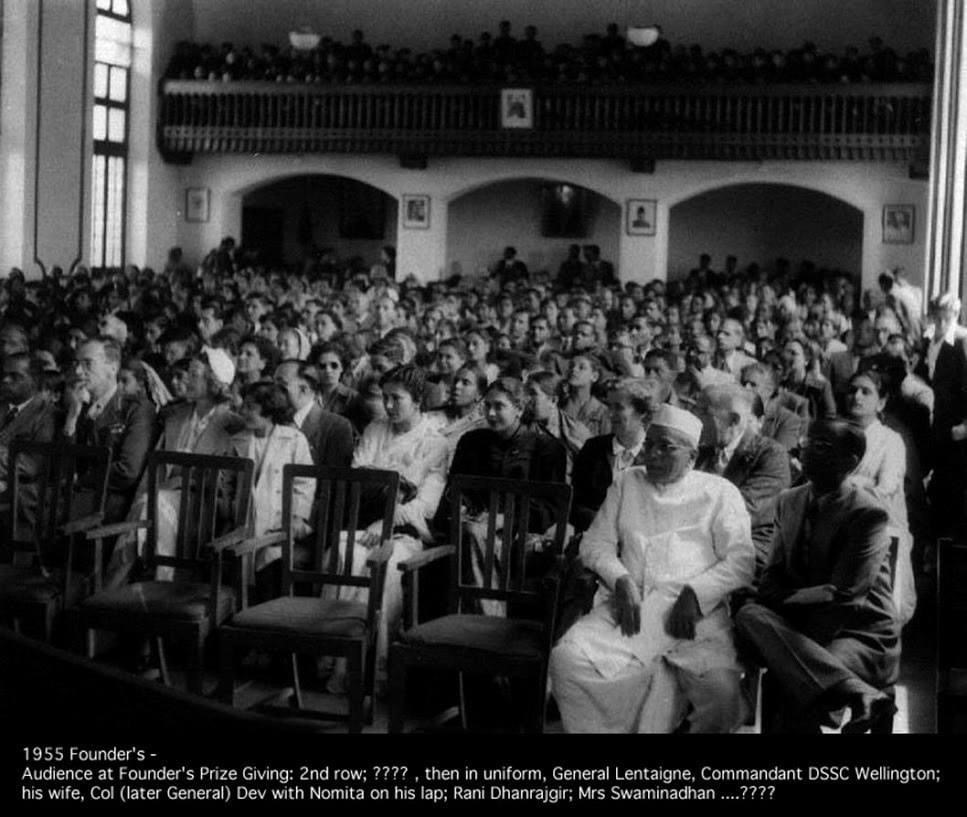
In the first Photo below taken in 1955 is General Lentagne, the BRITISH officer commanding what in my time was called Madras Regimental Centre, Wellington. This photo was taken in the Large Hall of Lawrence School, Lovedale. In the second photo is Nehru with the British Commander of the Indian Navy, Vice-Admiral Sir Stephen Hope Carlill. Both photos refer to the same period.

Finally, here is an extract from my Post Mrs Fowles and I showing beyond doubt that Military procedures in the school revolved round being loyal subjects to the King Emperor and had nothing to do with India.
Here is an extract from Glimpses of a Glorious Past written by Prem Rao, who was a year senior to me:
PRESENTATION OF COLOURS
TO THE SCHOOL BY HIS ROYAL HIGHNESS
THE DUKE OF CONNAUGHT AND STATHEARN , K. G.
On Saturday , January 15th, 1921.
The colour party now advanced, the Principal handed the King’s colour to H.R.H. from whom Albert Neale
received it kneeling. The school colour was similarly received by Cyril Neale.
H.R.H. then spoke as follows:-
“ It is a great pleasure to me to present these colours to the Lawrence Memorial School for I well know how
close and honourable is the connection that binds you to the British Army.
I congratulate your Principal and your Officers on the distinguished record your school has achieved and on
the very smart and workman like appearance of the cadets whom I see before me now. I trust you will look upon these colours as the emblem of your duty to your school and country and I hope that many of those who are henceforth to serve under these colours will live to serve, The King Emperor with honour and distinction in the larger spheres of life.”