I must begin by congratulating the late Nitya Mathai, my friend and housemate Prem Rao, Mr Thomas George, Mr Joseph Thomas and various others for their sterling efforts in putting together the History of the School, and the various events that took place that gives the impression that the School had a glorious past. The School did indeed have a glorious past but not for us Indians nor for our Indian ancestors. This was a British Institution created by the British for the British. Indians were excluded for which I have provided documentary evidence.
My intention is not to dismiss the efforts of my friends mentioned above but to demonstrate that there is an alternative view and that readers must make up their minds as to whether the past is ‘Glorious’ or shameful from the point of view of us Indians. In this respect, I have chosen 4 claims made and I am putting forward a contrarian view consisting of 2 posts:
Here is the link to Glimpses of a Glorious Past. Do refer to the three books included within the blog covering various periods covered.
Visit of Lord Lytton

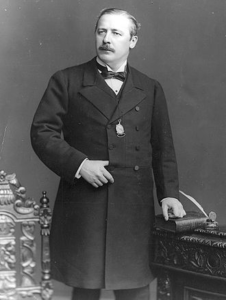
The claim made is that following the Proclamation Durbar of 1877, the then Viceroy paid a visit to the School. He was 46 years old. The British would indeed have considered the event glorious but look at the reality:
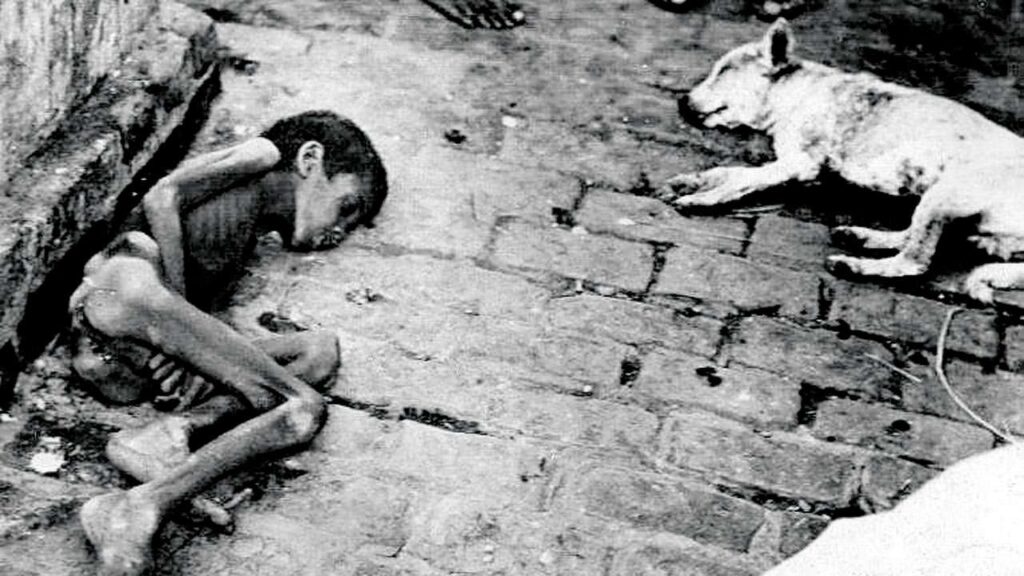
- Lord Lytton presided over a famine that killed 10 million Indians. Here is an extract from Late Victorian Holocausts:‘ Millions more had reached the stage of acute malnutrition, characterized by hunger edema and anemia, that modern health workers call skeletonization. Village officers wrote to their superiors from Nellore and other ravaged districts of the Madras Deccan that the only well-fed part of the local population were the pariah dogs, “fat as sheep,” that feasted on the bodies of dead children:After a couple of minutes’ search, I came upon two dogs worrying over the body of a girl about eight years old. They had newly attacked it, and had only torn one of the legs a little, but the corpse was so enormously bloated that it was only from the total length of the figure one could tell it was a child’s. The sight and smell of the locality were so revolting, and the dogs so dangerous, that I did not stay to look for a second body; but I saw two skulls and a backbone which had been freshly picked.‘
- Florence Nightingale said ”The more one hears about this famine, the more one feels that such a hideous record of human suffering and destruction the world has never seen before.
- Lord Lytton organised the immense Imperial Assemblage in Delhi to to proclaim Victoria Empress of India – according to The Times ‘the Viceroy seemed to have made the tales of Arabian fiction true.
- ‘His pageant had the nakedness of the sword on which we really rely’.
- The event included a week long feast for 68,000 officials, satraps and Maharajas, the most colossal and expensive meal in World history.
- 100,000 of Queen Victoria’s subjects starved to death in Madras and Mysore in the course of Lytton’s spectacular Darbar. Indians in future generations remember him as Nero.
- The British had replaced Gram (channa or chickpea) with cotton.
- He claimed the ‘Indian population has a tendency to increase more rapidly than the food it produces from the soil.
- His Minister Baring was against any welfare schemes as these encouraged unsuitable population increase.
- He went to War against Afghanistan at India’s expense.
- Having suffered a nervous breakdown in 1868, he was already addicted to and addled by opium
- He was Queen Victoria’s favourite poet and he wrote rubbishy novels under the pen name Owen Meredith.
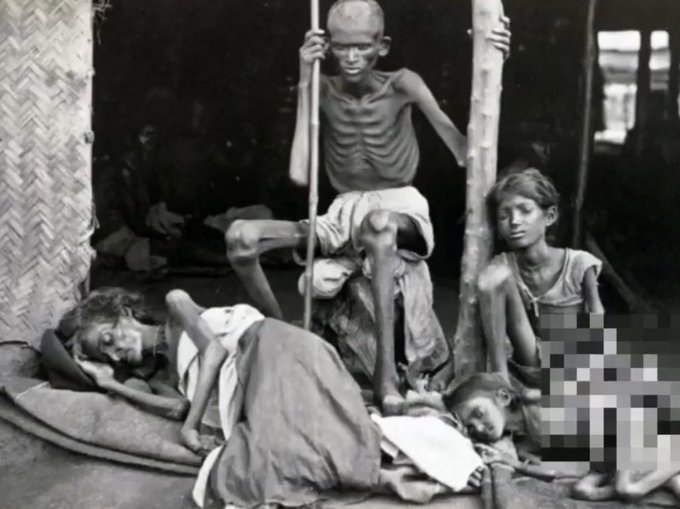
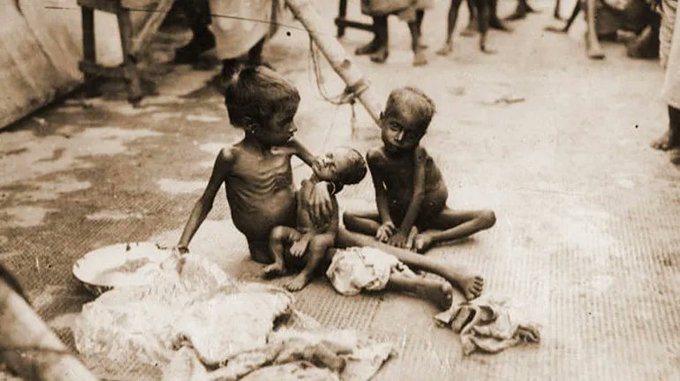
Below is a photograph of the famine in Madras when Lord Lytton was visiting Lawrence School.
Note the starving man guarding his family against cannibals
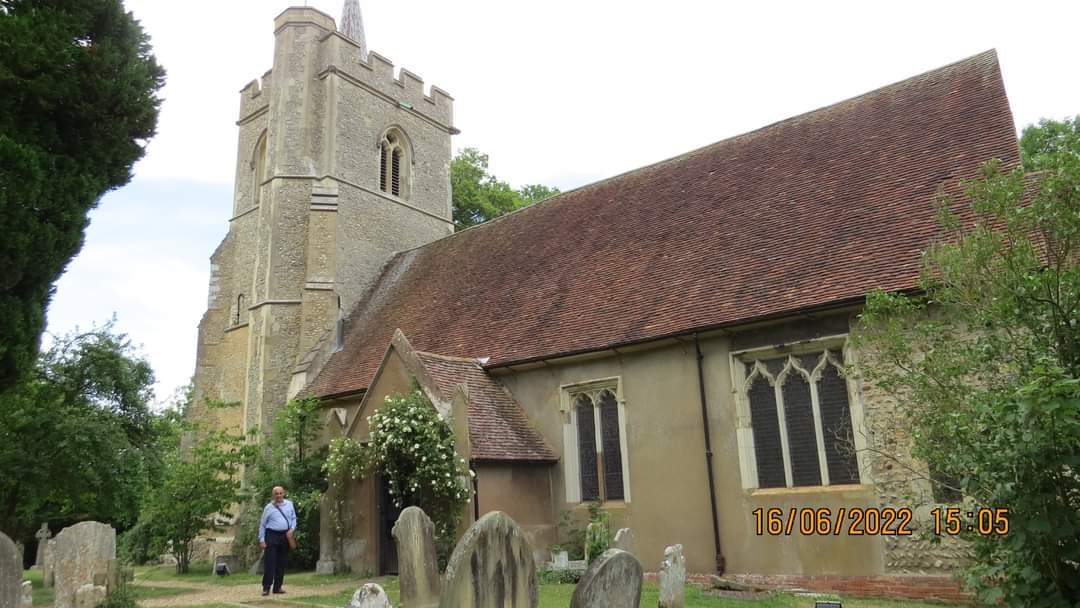
See below: Jitu’s visits to Knebworth
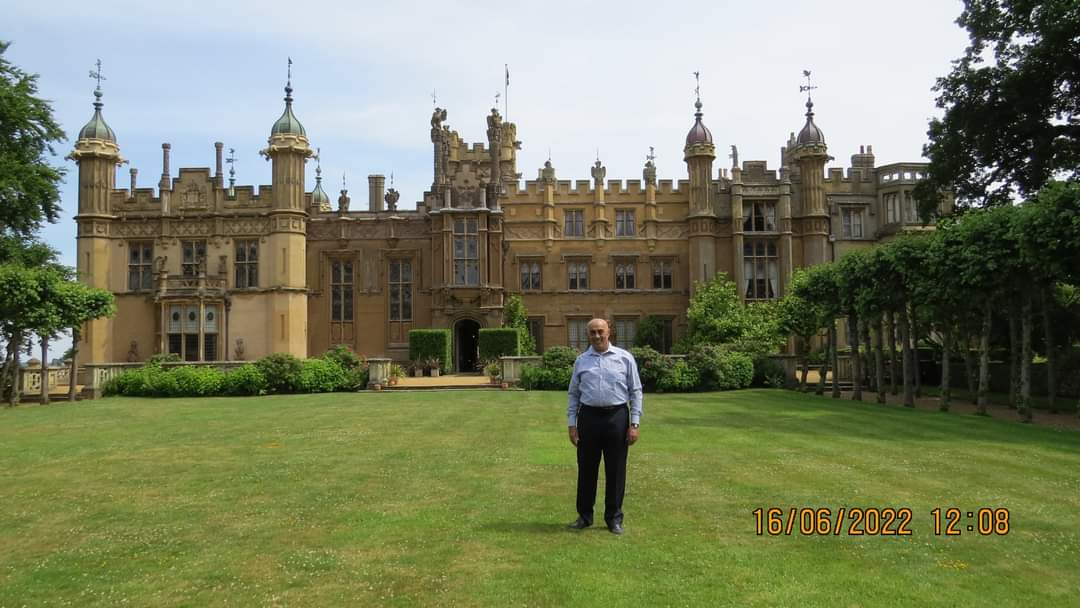 Outside Knebworth House

As a matter of interest, Lord Lytton’s son-in-law was the architect Lutyens. Read this article by Pavan Verma and in particular what he thought about Indians:
‘In the context of the recent changes in the Lutyens Bungalow Zone(LBZ) of the capital of India, New Delhi, I think it is important to rise above the reflex politics between those who do not approve of such changes, and those who do.
I do not subscribe to the theory that all aspects of what was built or named earlier should be fossilized in perpetuity. Nations which have been colonized need to reclaim their history, and erase some aspects of colonial servitude. Colonialism’s biggest success is not the physical subjugation of a people but the colonization of their minds. The colonized mind continues to hang to the coattails of its former masters -their language, culture, choices – long after the political end of colonialism. A mature, newly independent nation, therefore, needs to decide what to keep of the past, and what to jettison or modify.
The debate about Lutyens’ Delhi has clearly revealed these divisions. One school vehemently believes that his architectural legacy is sacrosanct, and any changes to it are a violation of our historical heritage. Another school is convinced that changes to that legacy are not only desirable but also necessary, given new priorities and in the interests of our own stamp on history.
Lutyens may have been a talented architect for his times, but he was obnoxiously racist, holding the ‘natives’ and their culture in complete contempt. Nor did he make a secret of his feelings. His letters to his wife from India – later published as a book – are a litany of everything that is wrong about Indians, referring to them repeatedly as “scallywags”, “blacks”, “loony”, “degenerate” and full of “awful habits”. His most vocal condemnation was of Indian architecture. “Personally, I do not believe there is any real Indian architecture or any great tradition”, he wrote. “They are just spurts by various mushroom dynasties with as much intellect in them as any other art noveau….And then it is ultimately the building style of children”.
He was convinced that anything at all redeemable in Indian architecture was due to the influence of the West, but even that was destroyed by the natives. “The Hindus knew little and the Moghuls little more of any ethic of construction…”. Even the magnificent Taj Mahal did not amount to much for the man. “People go head over heels with their admiration for the Taj, but compared to the great Greeks, Byzantines, Romans, even men of the calibre of Mansard, Wren etc., it is small but very costly beer, and alongside the Egyptians it is evanescent”. Indian craftsmen drove him to despair. “They know only the most terrible patterns, (are) foolishly method-less…Thank Very God of Very God that he wrought not our world on such lines…”
The short point is that Lutyens was an unabashed spokesman of British imperialism who built the Viceroy’s Palace, and the principal buildings of Lutyens’ Delhi as a symbol of the glory of the British Raj, and considered Indians to be primitives as yet on the verge of civilization deserving to be ruled in perpetuity. It is not surprising, therefore, that the greatest concentration of Indian motifs – elephant legs and sandstone bells – is found in the service entrance and the guardhouse of Rashtrapati Bhavan.
Can the views of the builder not inform what he builds? And, if that is so, can everything he built be beyond all interrogation or change? In 2002, the Charter of The Indian National Trust for Art and Architecture (INTACH) on Lutyens’ Delhi went so far as to say that the names of the streets of LBZ should never be changed. Article 13 of the Charter states: “The constant rechristening of streets and lanes in commemoration of national leaders, visiting dignitaries and tragic victims might flatter some egos and serve short-sighted ends, but they rob the city of its historic associations”.
I’m afraid I cannot agree with this viewpoint. Some ‘historic associations’ from recent history need to be preserved, but it is equally important for a nation with a civilizational history going back to the dawn of time to resurrect icons from its own past. There can be a debate on what needs to change, in what degree, and through what process. But some changes are apt. I cannot for the life of me understand why Dalhousie Road should not – as INTACH seems to want – be changed. His name has no resonance for Indians, except to recall the manner in which he robbed India. Also, in the first years after Independence, when most of the roads in the LBZ were given new names, our historical imagination was too north-centric. So while there are roads in the names of almost all the Moghul emperors, there is no road bearing the name, for instance, of Krishnadeva Raya (1471-1529 CE) of the Vijayanagar dynasty, considered one of the greatest rulers of Indian history. Nor is there a road after Raja Raja Chola the Great (985-1014 CE), under whose reign Indian culture saw a remarkable renaissance. Similarly, Lutyens’ Delhi continues to spectacularly neglect our great writers, poets and artists. Why are there not, for example, roads or other town features named after Tulsidas, or Thiruvalluvar, or Mirza Ghalib?
Now that the new Central Vista has been completed and inaugurated, it appears to have been welcomed by people at large, although critics still question the need for excessive paving and concretization at the cost of the green cover, and worry about the impact on efficient drainage. They also question whether this massively expensive exercise should have been done when Covid was at its height, and funds were needed for other priorities. The manner in which the selection of the architect was made, and other permissions processed, also cause concern. The Supreme Court overrode these objections, and there is merit in the view that preserving the past cannot preclude all changes determined by new priorities.‘
PRESENTATION OF COLOURS TO THE SCHOOL BY HIS ROYAL HIGHNESS THE DUKE OF CONNAUGHT AND STATHEARN , K. G. On Saturday , January 15th, 1921.
‘Punctually, on Saturday at 8 a.m., H.R.H arrived at the entrance to the pandal and was met by Their
Excellencies, The Governor and Lady Willingdon. His Excellency then presented Sir William Marshall, Mr.Knapp
and Mr.Berridge as representing the School Committee and the Principal (Padfield) to His Royal Highness. H.R.H then
proceeded to dais, where he was met by the Bishop of Madras and his Chaplain. The School Band played.“ God
Save the King” and the cadets presented arms.
After prayer, The colour party now advanced, the Principal handed the King’s colour to H.R.H. from whom Albert Neale
received it kneeling. The school colour was similarly received by Cyril Neale.
H.R.H. then spoke as follows:-
“ It is a great pleasure to me to present these colours to the Lawrence Memorial School for I well know how
close and honorable is the connection that binds you to the British Army.
I congratulate your Principal and your Officers on the distinguished record your school has achieved and on
the very smart and workman like appearance of the cadets whom I see before me now. I trust you will look upon
these colours as the emblem of your duty to your school and country and I hope that many of those who are
henceforth to serve under these colours will live to serve, The King Emperor with honour and distinction in the
larger spheres of life.”
The colours unfurled and turned towards the centre of the line were given a general salute – the colour party
marched in slow time to its place in line, the band playing “God Save the King”
The platoon headed by the band, then marched passed in line.
After the presentation, H.R.H. expressed to the Principal the pleasure which it had given him to present the
colours to a school with such a splendid history and complimented him on their smartness and efficiency. His
Excellency then sent for Mrs. Padfield and presented her to H.R.H. The large and distinguished gathering present
were loud in their commendations letter received by the Principal in his Excellency’s own handwriting will no doubt
help to inspire succeeding generations to keep up to the standard set by the present boys.’
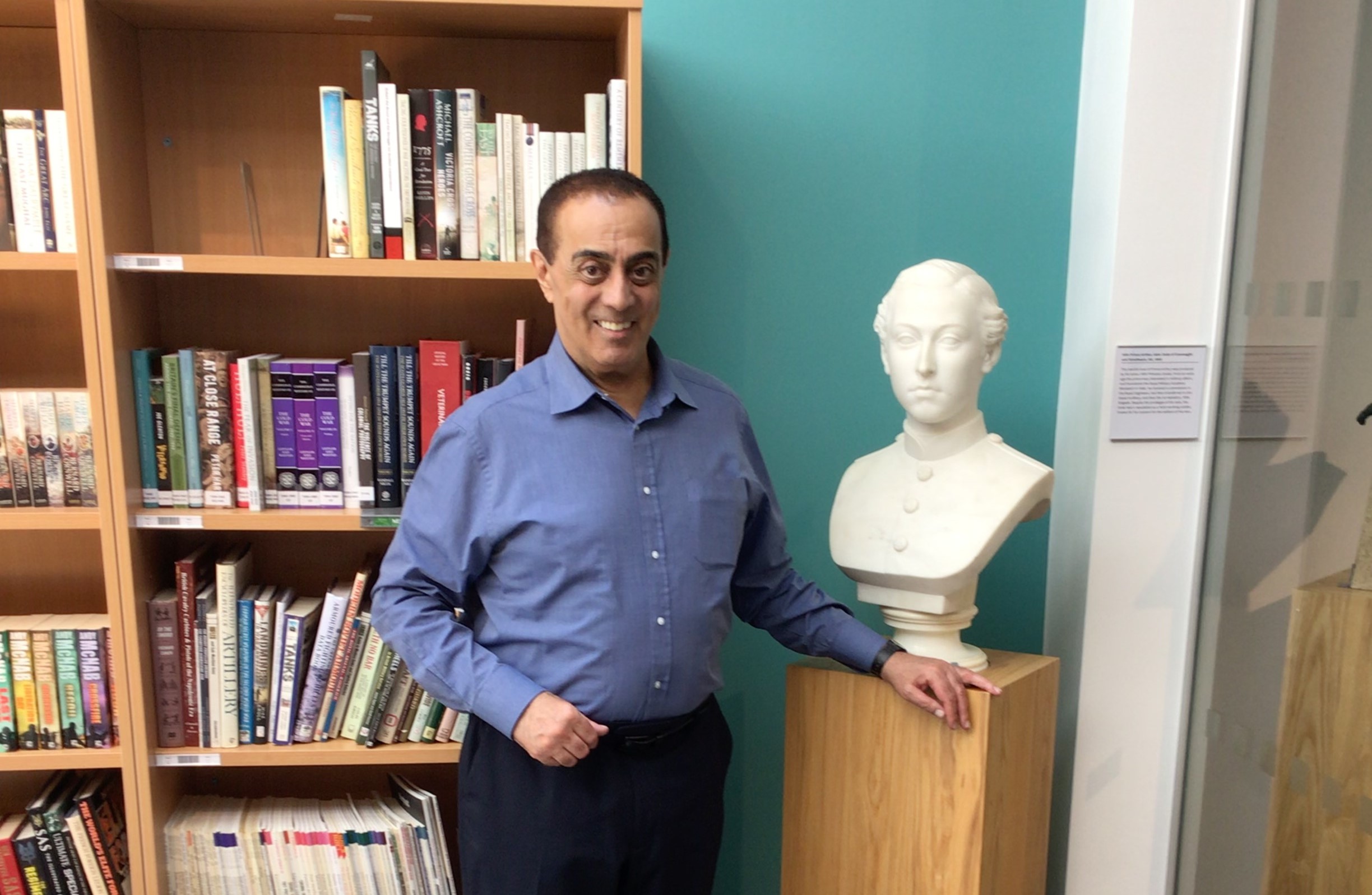
Note From Jitu Savani: Albert and Cyril Neal mentioned above were the brothers of the sadistic Mrs Fowles (nee Phyllis Neale) who I had the misfortune to be under. I was 6 years old at the time. See my Page Mrs Fowles and I
In any case, being awarded the status of Royal Military School was meaningless as far as Indians were concerned. Here is an extract from Case for India by Will Durant: ‘The second cast in India is the British Army. The Indian forces number some 204,000 men, 60,000 are British, including all officers; 1874 of them are aviators – the last resort of despotism. There are only a few Hindu officers, and no Hindu is allowed to join the air force or artillery, but 70% of the common soldiery are natives. The Hindus are reputed by the British to be incapable of self-defence, but no British Government has been willing to believe this to the extent of allowing Hindus to learn the art of incorporated murder. The expense of maintaining this army whose function is the continual subjugation of India by the bullets, shells and air -bombs, is borne by the Indian people. In 1926 its cost was $200,735,660-a tax of 8% on the scanty earnings of every man woman and child in the land.’
As for the Governor Willingdon, here is some interesting History that will rain on the parade of ‘Glorious’ Past:
This is the same Willingdon whose Wikipedia entry reads as follows:
‘In 1917, the year before Willingdon’s resignation of the governorship, a severe famine broke out in the Kheda region of the Bombay Presidency, which had far reaching effects on the economy and left farmers in no position to pay their taxes. Still, the government insisted that tax not only be paid but also implemented a 23% increase to the levies to take effect that year. Kheda thus became the setting for Gandhi’s first satyagraha in India, and, with support from Sardar Vallabhbhai Patel, Narhari Parikh, Mohanlal Pandya, and Ravishankar Vyas, organised a Gujarat sabha. The people under Gandhi’s influence then rallied together and sent a petition to Willingdon, asking that he cancel the taxes for that year. However, the Cabinet refused and advised the Governor to begin confiscating property by force, leading Gandhi to thereafter employ non-violent resistance to the government, which eventually succeeded and made Gandhi famous throughout India after Willingdon’s departure from the colony. For his actions there, in relation to governance and the war effort, Willingdon was on 3 June 1918 appointed by the King as a Knight Grand Commander of the Order of the Star of India.
I must at this stage mention ‘House Names’ and a trophy:
Lawrence: Needs no elaboration as I have written extensively about him in Pages within this blog.
Padfield: Please see my Page Principal Padfield and The Gated Community.
Hope Grant House: This was named after General Sir James Hope Grant. who distinguished himself against the Sikhs, suppressed the ‘Indian Mutiny’ including the relief of Lucknow and played his part in the Opium Wars with China. The ‘Sikhs’ in question were our kith and kin and so were the ‘mutineers’. The treatment meted out to the ‘mutineers’ was inhuman beyond belief. The Opium wars were totally unjustified as they involved forcing the Chinese to buy Opium produced in India and which earned the British handsome profits.
Murray Hammick House: Named after Sir Murray Love Hammick, a career civil servant whose ultimate achievement was Acting Governor of Madras from March 2012 to October 2012.
Winning the Milner Trophy cannot be regarded as ‘glorious’ past. It was named after a British civil servant, Lord Milner, of German origin whose service was confined to South Africa and had little or nothing to do with India.
Visit of Prince Henry
Here is an extract from Glimpses of a Glorious Past:
LMRMS, LOVEDALE IN THE 1940s
July 3, 1942 was a red letter day in the history of The Lawrence Memorial Royal Military School, Lovedale. On that day, His Royal Highness Prince Henry, the Duke of Gloucester, younger brother of the reigning King Emperor George VI visited Lovedale. This was the very first visit by a member of the British Royal Family in the history of the school.

Unfortunately, the heavy monsoon rains that day prevented the School from arranging an outdoor parade but His Royal Highness visited the Boys’, Girls’ and Prep Schools.
Shortly after, His Majesty, the King Emperor graciously acceded to the School’s request that His Royal Highness Prince Henry be the Royal Patron of the LMRMS.
Reality is that Henry’s visit was when the Bengal Famine was imminent. Rangoon had already been bombed. Millions of refugees had arrived into Bengal from Burma and elsewhere but there were no food stocks. When the Bengal famine did strike a few months later, 4 million Indians perished. Shamefully, the School was looking after dozens of British children evacuated under the Special Emergency Department scheme. Under this scheme, some White British children were actually sent from UK to India to escape German bombing. See my Post: School Reports Sent to British Army and within that Bengal Famine and Lawrence School Lovedale. What is so glorious about the visit to the school of the member of the British Royal Family when at the same time millions of Indians were perishing?

Alleged Glorious Past v Reality Part 2 – Goofy

I must begin by extending unequivocal praise for the presenters Elizabeth Varghese, Sujata Bisaria, Sangeeta Venkatesh and T.T. Job. I knew T.T. Job very well indeed as he was involved with the aero-modelling club; I was one of the little boys who were fans of that club and indeed helped in locating a model plane that had gone off course and landed in Ketti Valley! I also was hanging around when he was posing for the sculpture of himself by P.E. Thomas. I would have been far too junior for him to remember me!
I would be dishonest if I went along with all that was said in this episode. There was a huge difference between what was given at Lovedale and what was expected for the colossal costs incurred by my father in sending me there. Being humiliated by a ‘temperamental’ (not my description) Music Master was not included in the package!
Jitendra Pratap was known by one and all as Goofy.
This episode of Glimpses of a Glorious Past is a classical example of truth being murdered, inadvertently, of course. Perhaps to appease and comfort Goofy’s children, against whom I have no animosity at all. These children were in the school when I was there but none of them distinguished themselves in any way. Like most others, I didn’t even know that he had children in the school until I saw this clip. His children probably stayed on in the school after the fool left, by special arrangement relating to fees as the earnings of a former Music Master simply wouldn’t be enough to pay the fees of four children unless there was help from his journalist father Thakur Chandan Singh.
In the video clip, various photographs are shown of a young man/boy playing the sitar. These were certainly taken when Goofy was a teenager as by the time the photo of him in 1959 was taken, he was already looking middle-aged. Other photographs were shown of various prominent personalities from the Indian music world and tenuous links established. All this is irrelevant; having tenuous links with others from the same profession does not make one a maestro in that profession!
Truth is that this odious character was known as Goofy. Throughout the period I was in school he was known as Goofy and only Goofy! Hardly anybody knew him as Jitendra Pratap. I was one of the few who did, as his first name is the same as mine. The honorific ‘Pandit’ was allotted to him probably after his death as nobody in the school or long after he left knew him to be a Pandit. Who allotted the honorific remains a mystery. It may well be that it was made up by the producer of the video!
There was a reason he was known as Goofy and that reason is as valid today as it was then. This character was a bumbling fool most of the time. I recall clearly a parent proffering him a filter-tipped cigarette. Goofy took it and put the tobacco end in his mouth. He tried desperately to light the filter-tipped end but failed. It was the parent who pointed out, very gently indeed, the error of his way. On those occasions he wasn’t bumbling, he was a dreadful bully who picked on 10 year old boys and only 10 year old boys. This was for two simple reasons: 1. There were no boys younger than that for him to pick on and 2. Those boys he picked on couldn’t possibly retaliate.
Certainly I was one of the boys he picked on frequently and for no reason. I resented it then, and now, 63 years later, I resent it more! My father didn’t pay a fortune in fees and airfares for his son to be humiliated by a bumbling fool passing himself off as a Music Master!
The fool joined the school in 1956 as a 36 year old. I joined a couple of years later aged 6. in the years 1958 to 1961, I was in Prep School where hymn singing was unknown; instead we were taught rubbishy Western pop songs. Not surprising as those in charge of Prep School were Anglo-Indians like Mrs Enos, Miss Prince, Miss Dudley and Miss Stokoe. The fool Goofy was nowhere to be seen, I don’t recall him visiting Prep School even once! Thus we never had the benefit of his alleged skills in teaching Indian Music all those years.
Come 1962, we went up to Junior School and the fool was at Assembly every morning. When boys were filing out in a disciplined and orderly way, he would pick at random 9 or 10 boys and make them stand on the chairs as punishment for some alleged act of indiscipline. Reality is that there was absolutely no act of indiscipline; 10 year olds would be petrified of 16 year old prefects who came to junior school on a daily basis to meet out punishment anyway; the fool just wanted to embarrass those 10 year olds he picked on as all the other boys and girls would stare at those standing on chairs, thus humiliating the fool’s victims. His bullying and humiliating of young boys had one objective; the fool wanted to endear himself to the senior boys. Of course, he dare not bully any of the senior boys even though they were more likely to have exhibited indiscipline; he was too much of a coward for that! He would have been given short shrift. Did the fool endear himself to the senior boys? All he succeeded in doing was making more of a ‘Goofy’ of himself.
The clip implies that the fool went from Lawrence Lovedale to Lawrence Sanawar. This is a half-truth. Full truth is that he left Lovedale as his wife Monica ran away because she couldn’t stand his bullying. The fool went in search of her. Whether he found her or not is anybody’s guess.
Going from one school to another, which he did frequently, is not evidence of his teaching skills. Far from it! He couldn’t hang on to a job in one place!
Getting assignments as a critic was just evidence of his desperate need for money. Obviously the more the hatchet job he did in his criticism the more attention he brought to himself. I personally read his critiques of such Hindi film industry icons as Ravi and Chitragupt. I even wrote to the newspapers publishing his critiques objecting to his uncalled for rudeness and derision. It wasn’t as if he was criticising classical Hindustani music composers; he was criticising composers of popular Hindi music just for the money! Far from giving any impression that he was being tough but fair it was obvious that he was doing a hatchet job. I know, as I am a connoisseur of Hindi film music and have been for decades. Not that it mattered much; the musicians the fool criticised achieved phenomenal success while the fool received his filthy lucre.
In the videos below the music for Chaudvi Ka Chand was composed by Ravi a music composer heavily criticised by Goofy and the next two, the second one sung by Pakistani singer Sara Raza Khan, the videos are of Rang Dil Ki Dhadkan for which the music was composed by Chitragupt . These were major hits in India and Pakistan and continue to be popular 6 decades later wherever there is an Indian sub-continent diaspora including U.K., USA, East Africa, South Africa, Fiji, and the Caribbean.
I do know what I am talking about; the extended Savani family were in the Cinema business since the 1920s, see article here:
Awaz (Read Page 7 onwards). In fact, the famous Embassy Cinema of Nairobi was just opposite my house. Many a famous Indian actor and singer visited!
All the name dropping in the production of this clip was just that; name dropping. Any school of music would have pupils and he was just one of them! One has to consider a simple fact; this Nepalese fool’s training, according to this video clip was in North Indian (Hindustani) classical music so why on Earth would he come down South to ‘teach’ his type of music to mainly South Indians and Anglo-Indians? One would be perfectly justified in concluding that he was desperate to find a job! With four children and a wife to support, he must have been very desperate! Lawrence School, Lovedale provided free accommodation, free food for him and his children, free uniforms, free education for his children and various other perks.
As for the school song; yes it is fondly recalled, and it brings memories; yes it is frequently sung at Old Lawrencian get-togethers. However, is it a classic? Certainly not! It is more a poor piece of pop! Most of those singing it have never known the meaning of the words; certainly not the Tamilians, Malayalees and other non-Hindi speaking students. I doubt it was composed to resonate with any known raag. Certainly, K I Thomas who assigned the composition of the song to the fool had no choice. When composed, India had been Independent a mere 11 years, up until then there was a perfectly good English school song which is still sung at Old Lawrencian meetings in London and other places. That song wasn’t composed in 24 hours. In any case why wasn’t the tune in resonance with Karnatic music? After all the school is located in South India! Why were the words in Hindi and not Tamil? After all, one of the hymns we were required to sing was Odi padete Kani Nai Wa Wa Wa which is in Tamil.
As for the fool’s knowledge of Karnatic, Western Classical and other music, that is made up crap! When and where did his alleged knowledge come from? The video doesn’t mention a single Karnatic music maestro under whose tutelage the fool gained any knowledge!
School Song in Hindi composed Jitendra Pratap (Nepalese speaker) and translated by J. Asrani (Sindhi speaker)
School Song in Hindi (Devnagari) Script
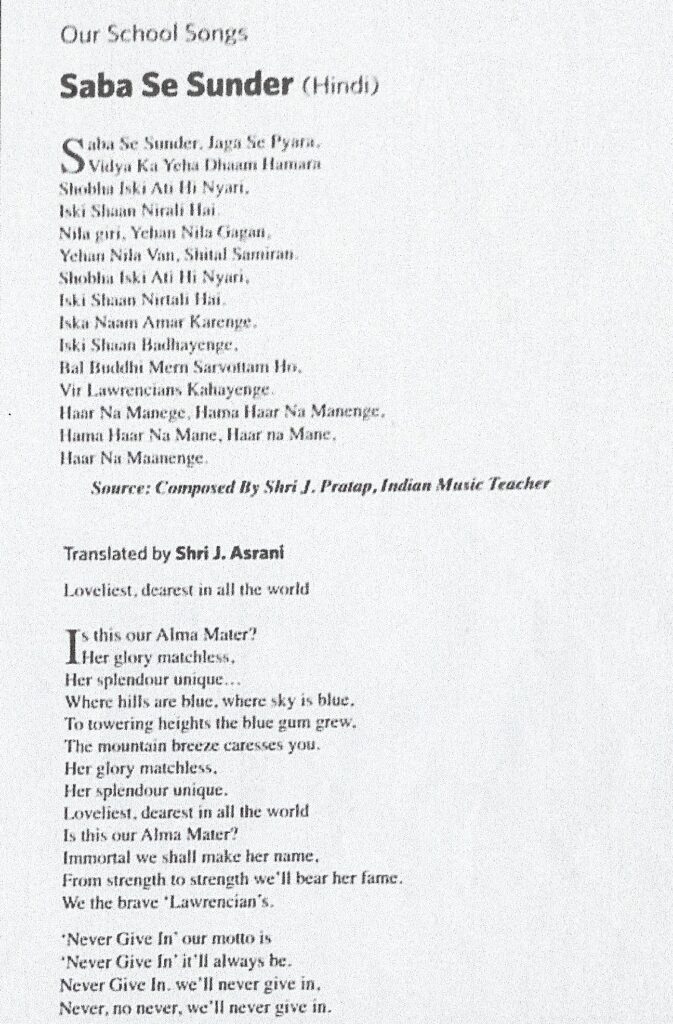
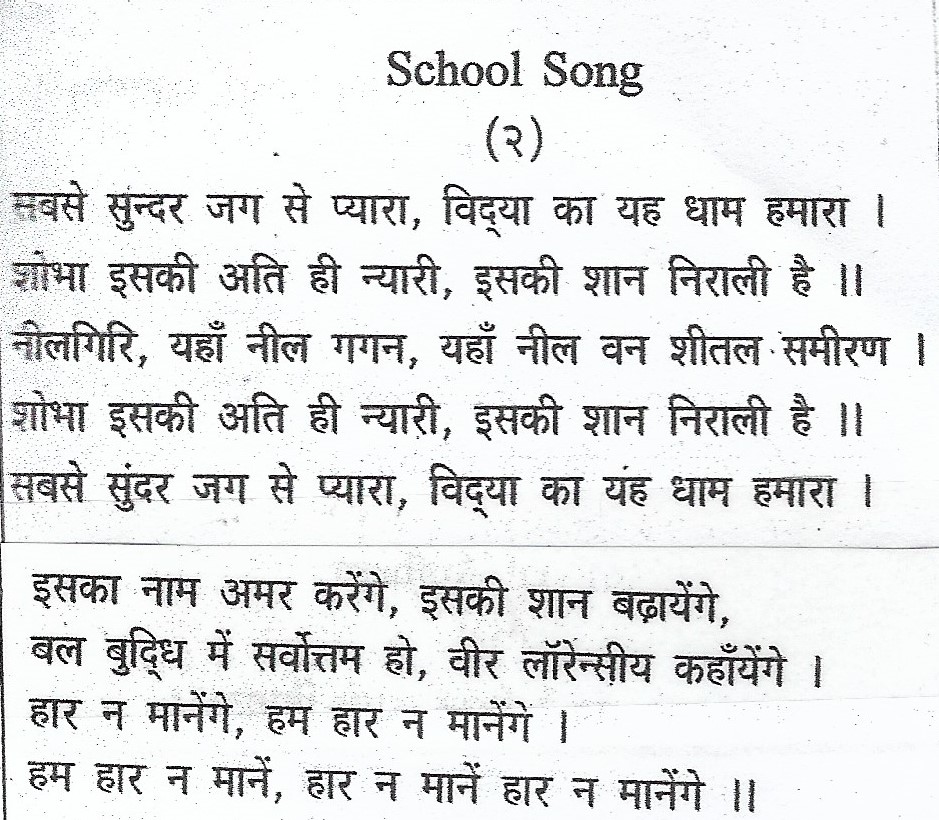
School Song translation by Hindi speaker
The most beautiful, the most lovely,
This place of education of ours.
It’s grace is absolutely beautiful,
It’s pride is amazing.
Nilgiri, here the sky is blue, blue is the forest and a cool breeze.
It’s grace is absolutely beautiful,
It’s pride is amazing.
The most beautiful, more lovely than the whole world,
This place of education of ours.
We will make it’s name eternal,
We will increase it’s pride.
May we be the best mentally and physically,
We will be called brave Lawrencians.
Will not accept defeat,
We will not accept defeat.
We will not accept defeat,
Not accepting defeat, we will not accept defeat.
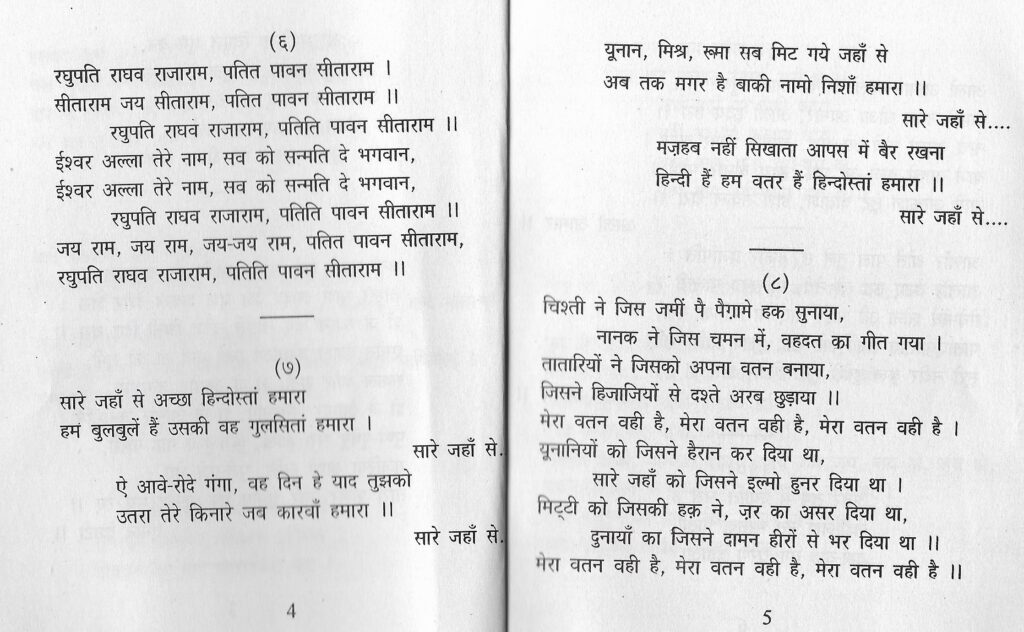
Iqbal’s Songs (In Hindi Script) Sung At Assembly and taught by Jitendra Pratap a.k.a. Goofy
Lower part of page 4 and whole of page 5
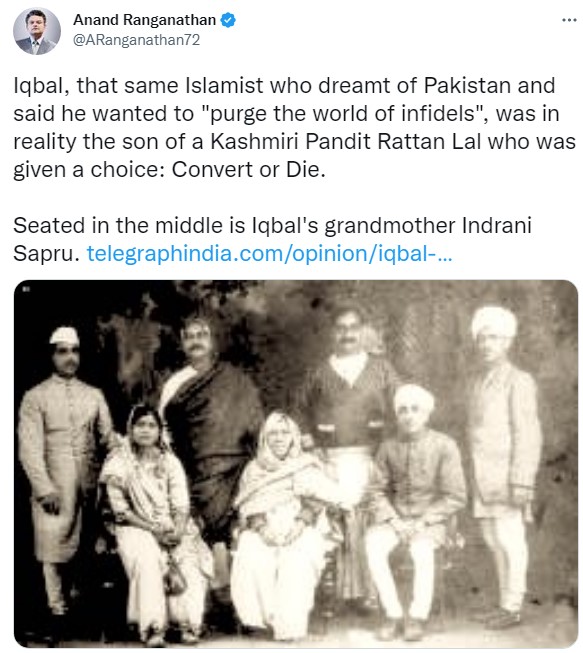
Below is what Iqbal was described as:
Glimpses of a Glorious Past and Other Videos
These videos refer to various aspects of school life with questionable references to glory.
In the bottom right video above observe the choice of songs from 1 hour 14 minutes on: Beatles, Black Magic Woman, Dancing Queen, Hotel California, Obla Di Obla Da, Lets Twist Again, Give me everything, Jailhouse Rock, November Rains, I got a feeling (Black-eyed Peas), Chasing Cars, Cliff Richard. Only one Indian song, Surangani!!!
In the bottom left video listen to Denzil Prince from 2 hours 2 minutes on describing the house mistresses video: ‘If they felt like caning you, they did!’ When I joined in 1958, aged 6, Matron Teressa and her sidekick Rosy ayah, didn’t use the cane; their slaps, pinching, hairpulling was infinitely worse! When such torture was meted out to defenceless 6 year olds, it was sadism!