Please also see Lawrence’s military incompetance
Note from Jitu Savani: Headmaster Lahiri was hounded for daring to question the ‘Parades’. I have various Pages within this Blog that are even more emphatic in questioning this bogus ritual of ‘Parades’. My various reflections will prove beyond peradventure that the ‘Founder’, Sir Henry Lawrence in whose honour the annual farce is held was in reality nothing more than a colonial tax extorter employed by the East India Company (a thoroughly disreputable joint stock company), who treated INDIANS, the ancestors of the very people honouring him, abominably. My notations will show that he was quite prepared to use military force to extort taxes from the poorest of the poor INDIANS. Further, the colonial tax extorter had no compunction in casually hanging ’20 or 30′ INDIANS (see my Page: Lawrence’s Military Incompetence).
It is appalling that the Founder of the School, the very person who specified IN WRITING that only Christian children, both of whose parents were EUROPEANS were to be accepted into the school is being honoured by the very children he wanted excluded! It is appalling that an incompetent military man of the East India Company Army and not the British Army is being honoured with a military parade!
It is appalling that the Founder whose wife Lady Honoria was a vile racist fundamentalist Protestant child beater, who referred to Indians as ‘heathens’ is being honoured by those very ‘heathens’!
Now read this extract from ‘With a Little Help from My Friends, Dev Lahiri’s book:

The one elephant in the room, which, however, no one had been willing to acknowledge so far, was the issue of Founder’s Day. It is very difficult to explain to anyone who has not been to Lawrence what the Founder’s Day obsession is all about. It was scheduled in May each year, but the spirit was in the air as soon as students returned from home after the winter vacation in January.. The final examinations (which were scheduled in March) were regarded as a minor irritant on the way.
Traditionally it was the new class twelve who ran the preparation for the Founder’s Day and it was the attempt of each batch to outdo its processor’s performance. The celebrations themselves were spread out over three days in May, but the centrepiece of the entire event was the parade and the beating of the retreat. Every single student (unless medically exempt) had to participate in the parade and it was the duty of every guard commander (i.e. the boy in charge of each squadron) to ensure that his squadron was absolutely fine-tuned and faultless. In a school of 700 students, there would obviously be some who lacked the motor skills required to march in unison with the rest. The guard commander could not have any of this. The students had to practice relentlessly in the burning sun, till they got it right. If they did not, much harsher measures were put into effect.
It was hugely prestigious to be part of the band. There were, as a mater of fact, three of them; a brass band, a pipe band (all girls) and a bugle band. Whilst the beating of the retreat was quite spectacular, the pressure to perform flawlessly was enormous and hours of practice went into the effort. It went without saying that in attempting to outdo the previous year’s performance, the guard commanders and band leaders (among boys), did very often exercise brute force. I remember having to deal with some seriously traumatised little drummer boys who had been beaten black and blue in order to get the best out of them.
The other issue was time. The demand to stop classes and concentrate exclusively on Founder’s Day began the moment the final examinations ended in March. In my first year I was horrified to see that virtually from April to the middle of May (when the school closed for the summer, (just after Founder’s Day), there were no classes. Over the years, I tried very hard to extend the working period in April, but the teachers complained that no one really cared about what was happening in the classroom and students could hardly wait to get out for practice.
This was, by no means, an easy call for me. I was fully aware of the fact that the parade and retreat were an integral part of the traditions of the school and something that the entire school community (including myself) was extremely proud of. Having been brought up in the army I appreciated more that most the importance of tradition. However, as an educator it was also my duty to provide the best possible opportunities to all students to compete with their counterparts from other schools in the cut-throat competition for admission to universities. We were losing more and more students each year from class ten. These students would seek admission to to a day school which they felt would prepare them better for the final board examination of class twelve.. I began wondering whether our students in this day and age could afford the inordinate time that they were spending on these activities? Somehow, a balance had to be found between tradition and the changing needs of the times.
There was yet another area where I had a philosophic disagreement (albeit a very personal one) with the entire business of military tradition. Somehow it seemed to me that with the education system itself already deadening creativity and stifling a spirit of inquiry, we, as a school, ought to be doing what we could to counter this trend, at least in areas over which the stranglehold of the curriculum did not exist. It appeared to me, however, that with all this emphasis on uniforms, hierarchy, marching and what-have-you, what we were doing was in fact, creating a culture that was antithetical to encouraging creativity and a free spirit. Children, I felt, ought to be allowed to grow unfettered, to breathe freely, to be excited about expressing new ideas. After all, were these not the demands of the new world order?
In my discussions with some of the alumni the counter they posed was, ‘But we all went through this system and are not any worse for it.’ What they were loath to admit was that there were an equal number of them who had some very bad memories of what they had been through. And of course, I was always told that even Anjolie Ela Menon was a product of this very system. Of course she was, and of course she is, one of the greatest artists in the country, but how many Anjolie Ela Menons might have slipped through the cracks because of the overbearing ethos of the system? And in any case, the boys school was far more ‘militarised’ than the girls.
1n 1999 when we began to examine the problem of our board examination results, these issues began to be discussed for the first time. It was the unanimous opinion of the faculty that the time, energy and effort spent on parade and retreat were seriously impinging on classroom time. In August 1999, the autumn of our discontent, I decided to take the elephant head on. I wrote a letter to all the parents pointing out the problem created by excessive emphasis on parade and retreat and sought their suggestions on this matter.
I concluded, ‘Gandhiji once said tradition is like a river, we can choose either to sink or swim in it. The time has come for Lawrence to make the choice, I look forward to receiving your invaluable reaction to this letter.’
Hundreds of parents started writing in. Some were of the opinion that parade and retreat were seriously outmoded and should be scrapped. Others said that we ought to just scale things down a bit. Some were of the opinion that the present system be retained. Funnily enough, most of the opposition to the parade and retreat came from parents from the defence services!
What I had not anticipated was the virulent reaction from a section of the alumni. The net went viral with what was called ‘Operation Fireball.’ The single aim of this campaign was to see me removed from Headmastership.
Some of the subscribers to this campaign said I was destroying the glorious traditions of the school, others said that I was a terror who ruled both staff and students through fear. It was alleged that I brutalised students. Funnily enough none of those who made the accusations had their children in school! Some pointed out that I had been wasting precious school funds on horse riding, not to mention my own time which should have been dedicated to the school. Some of the language used was enough to make anyone with any sense of decency cringe.
It did not end there. Indrani started receiving anonymous phone calls threatening me. The caller would say that they knew that I had a pacemaker and all that it needed was a magnet to neutralise it. My daughter was followed into the town, her photos taken and morphed. Matters got worse, Anonymous letters started arriving addressed to the student body, accusing me, amongst other things, of sleeping with the lady teachers and Indrani of sleeping with the men.
My mind, at that time, went back to a letter I had received from Admiral Raja Menon (husband of Anjolie Ela Menon) dated 15 September 1999, where he had written, ‘It (the parade) teaches above all the manly qualities of ‘steadiness’ which immediately differentiates a boy who had some drill from a lounging Delhi school product…’
If these were ‘manly’ qualities that Lawrencians had imbibed from the parade, I wondered whether schools were better off with ‘lounging’ products who were at least morally upright?
Of course letters like these were bound to have a devastating effect on the family as both our girls would certainly have been told about them by their friends. I, for one, did not have the courage to address the issue. Indrani had to step in and she told the girls, ‘There will be much more of this in the days to come. It is important that as a family we believe in each other.’ Enveloped as we were by the storm, it was easy not to notice the hell that Diya and Shama must have been going through as students of the school. To their credit they remained stoic throughout. It was only much after we had left Lawrence that I discovered how embittered they were, bits of which persist even to this day.
The head of a nearby Christian school arrived one day and asked us to hold hands with each other in prayer. A parent insisted that we undertake a trip to the temple of Guruvayur to seek blessings. Whilst I am not particularly religious, I must admit that in those tumultuous times, I too found some succor in these acts of support. I had never imagined that a letter written in good faith, with no personal axe to grind and aimed at benefitting the current students entrusted by their parents to the school, would evoke such a reaction.
After all, had I not for the last eight years helped facilitate some of the finest Founder’s Day celebrations the school had ever seen? I was also the first (and, so far at least, the last) Head of school to have actually (in the face of much opposition, I may add), a girl student to actually command the parade one year, in tandem with the Headboy. I had also added to the glamour of the entire event by introducing the practice of the horse-drawn buggy and mounted escort for the Chief Guest.
As a matter of fact, one of the younger alumni at the height of the crisis wrote to the entire fraternity, ‘Forget cancelling Founder’s, we had some of the best Founder’s under his (Mr Lahiri’s) watch. I still remember my eighth grade Founder’s, when in pouring rain the Beating Retreat was flawlessly performed while Mr Lahiri stood outside saluting and soaking wet the whole time, with the band.’
Moreover, I had never once suggested ‘scrapping’ Founder’s Day. I just did not have the authority to do so. All I had suggested was that we have a re-look at the kind of time and effort that we were spending on this exercise in view of the intense pressure of having to improve the Board examination results. Whatever my personal beliefs on the absurdity of the ‘marks syndrome,’ I felt thet as head of school, I could not disregard the views of a large section of the parents.
In an attempt to stem the flood I called for an emergency meeting of all stakeholders so that we could hammer out some compromise and present our findings to the Board. Very senior alumni were invited, as was the executive committee of the Parent-Teacher Association (called Friends of Lovedale Society) and the faculty. A lengthy discussion ensued and eminently sound advice was offered by the senior alumni present such as Jose Dominic and Viju Parameshwar. It was agreed that all that should be done, at least to begin with, was to cut down on the parade and retreat and reduce the time given off for classes for Founder’s Day.
The final paragraphs of the minutes read,
‘The meeting expressed full faith in the Headmaster and the staff and the commitment they had to the school and left it to them and the Board to effect whatever changes, however radical of the ‘Founder’s Show’, Parade and Band for the betterment of the school. The meeting concluded with an expression of appreciation for inviting such an open dialogue and involvement of all stakeholders of the school.’
Armed with this input, I decided to meet the Board at the next meeting and seek their views. But Operation Fireball had, in the meantime, found two redoubtable leaders in Anjolie Ela Menon, the internationally renowned artist, and her sister, the late Nomita Chandy. I was completely nonplussed at this turn of events, particularly because both of them had been frequent visitors to my house and had been very helpful with suggestions and new ideas. Anjolie Ela Menon had indeed written to me as recently as 19th Nov, 1999 stating, ‘I am fully aware (and have been a vocal advocate) of the many great things you have done for the school.’
As a matter of fact, at that point of time I felt that Anjolie, her sister Nomita and her husband Admiral Raja Menon and I enjoyed a relationship based on mutual respect. The three of them would dine with me whenever they happened to visit Lovedale and we would discuss school and related matters quite feely and openly. Nomita and I were, in fact, in the process of finalising a scholarship-based admission to Lawrence for an underprivileged child, sponsored by her Trust.
The much awaited Board meeting regarding Founder’s Day was held and the Board ruled that the celebrations should carry on as usual. I dutifully recorded the instructions and relayed them to to the school on my return. Imagine my surprise at receiving a letter forwarded by the Ministry of HRD dated 26:11:99 signed by Anjolie Menon, her husband Rear Admiral Raja Menon and her sister Nomita Chandy, in which they listed various allegations against me. These included ‘misappropriation of funds, manhandling little children, including girls, being against Bharatiya Janata Party (BJP) (the National Democratic Alliance led by BJP was then in power) and making anti-BJP statements.
While I had no idea where the first two allegations came from, I could see what might have have led to the anti-BJP ones. Close on the heels of the brutal killings of the Staines children in Orissa, I had been instrumental in organising a peace march of all Ooty schools to the office of the Collector. We had marched in silence and handed over to the Collector a petition signed by all the students participating that we wished to grow up in India where such incidents would not occur and there would be be peace and harmony amongst communities. I had also publicly denounced the destruction of the Barbri Masjid, just as I had in 1984, while teaching at Doon School denounced the massacre of innocent Sikhs. But now, I was being beaten with that stick and by the so-called intellectuals at that.
Meanwhile trouble was brewing on other fronts as well. While I was away at Bombay to meet R.K Krishnakumar, an ex-member of the Board, to seek his advice, T.Gundan, one of the Governors, visited the school with Nomita Chandy. I was informed that they had summoned a faculty meeting in my absence and let it be known that I was on my way out as Headmaster and that those amongst the faculty who wished to be in the good books of the new administration would have to sign a petition against me.
A petition, repeating much of what was being said in Operation Fireball, was drafted and sent to the Ministry and became part of the package of allegations against me. The fact that a large number of signatories later recanted and wrote to the Board informing them of their disassociation with the petition was never taken into consideration.
The petition had been forwarded through Narayan Rao, a Governor. I warned Narayan, who was also a very dear friend, that should such a petition be entertained, it would spell the beginning of the end. Dev Lahiri, I said, would not be there forever, but whosoever occupied the chair of the headmaster would perhaps have that Damocles sword over his head once a precedent was set. My warning was to prove to be prophetic.
In the meanwhile about two hundred parents wrote letters of protest to the Ministry, The Head of the Association of Schools in the Nilgiris and indeed the entire support staff sent in their protest against Operation Fireball to the Ministry as well. Their feelings were best summed up in a letter written by Viju Parameshwar, an alumnus and President of the Parent-Teachers Association. On the 17th December 1999 he wrote (and I quote):
‘4. Mr Lahiri has been good for the school as it is a far better place than it was six or seven years ago. Further, he seems to be the only person among staff that that many parents can relate to. What will happen to the children now without him in the immediate short term, particularly for the tenth and twelfth standards who have to do a board examination in two months?’
It was ironic that there was no mention of my inflicting any brutality on the students as alleged by some of the old students, either in this letter, or in the two hundred odd letters by the parents. The Board, however, had by now got caught in its own web of deceit and lies. AJ Tharakan, another alumnus and a member of the board, had written to me on the 4th June 1999, (and I quote):
‘Dear Dev,
Please convey my congratulations to all your staff on the excellent results that Lovedale has obtained in the CBSE examinations. It is indeed very satisfying as a Board member to see the consistent progress that Lovedale is making towards academic excellence under your headmastership.
I wish you continuous success
Yours sincerely
Sd
(Abe Tharakan)’
On 19 October 1999, AJ Tharakan once again wrote a mail, this time addressed to all the alumni, that read,
‘As a consequence of this present financial condition of the school, children studying in Lovedale virtually live in medieval conditions. The dormitories are falling apart. The plumbing and electric wiring are archaic and require immediate replacement. Living conditions in the Senior, Junior, Prep and Girls Schools are just appalling and the dormitories virtually inhabitable (sic). The Board, Headmaster and the Staff are fighting a losing battle to upgrade these living facilities. The toilets in the Prep School and Girls school have been upgraded to a certain extent. A central laundry facility and computer centres have been set up in the Senior school, Junior school and Girls school. Bullying , which had taken on frighteningly sadistic proportions has been stamped out. Credit for all this must be given to the present Headmaster.’
Now on 28 December 1999, the very same A.J. Tharakan wrote an impassioned plea to the Chairman asking for my removal. He claimed that I was ‘a pathological liar’, suffered from ‘a persecution complex’, flew into ‘uncontrollable rages’ and could not ‘control myself’.
Operation Fireball had acquired a life of its own!
Gul Panag’s Review of Dev Lahiri’s Book


Note from Jitu Savani: Read this review in conjunction with my Page Baby Krishna to Buchadkhana
The experiences set out here took place more than two decades after I left Lovedale. If only characters like Mac (see Page on Mac) had not abrogated their responsibilities bullying would not have reached such proportions.
Dev Lahiri was my headmaster at the Lawrence School, Lovedale. I have the fondest memories of him – as an orator par excellence, a man who commanded respect by leading from the front, and always by example. Maybe he was considered a bit stern. One of my batchmates attracted Mr Lahiri’s full ire for throwing ink (our new, nonviolent, democratic form of protest) at a physics teacher. He had a soft side too – in 1999, when I won the Miss India pageant, he named a newborn foal ‘Gul’, after me – much to my surprise, and that of his students at the time. In 2011, despite struggling with a heart problem, he made sure to be at my wedding.
Still I never had a full picture of the man until I read Mr Lahiri’s book, With a Little Help From My Friends – A Schoolmaster’s Memoirs. Reading it was both an enriching and a disturbing experience.
Enriching because though I knew him to be a man of extraordinary intellect (and a Rhodes Scholar), I was blown away to discover other talents. Long distance running, for instance – his first marathon (that’s 42 kilometres, non-runners) took him two hours and 43 minutes, which is really something. That was in 1975, representing St. Catherine’s College, Oxford, where he was also part of the student’s elected body, as he had been earlier in St. Stephens, Delhi.
Disturbing because after choosing an altruistic career, his journey was so difficult, so tumultuous – especially when it came to running and trying to reform institutions – that it could actually deter other well-meaning souls.
That a man so talented decided on a career in education might seem perplexing given that we naturally (and mistakenly) assume he would pursue personal gratification over making a contribution to society. All his life, however, he strived to set high standards with his personal conduct, even when easier options were available.
I was in school at a time when the menace of bullying had not even begun to be tamed. I routinely came to class to find boys with black eyes, bruises, even fractures. This is the awful baggage that old-world public schools carry and which no one wants to talk about. One of my batchmates had such a severe fracture to his wrist – from ‘hockey stick shots’ – that even the Military Hospital in Wellington refused to admit him and recommended a better-equipped institution for his treatment.
“We were bullied, so why shouldn’t we return the favour? It’ll make a man of the boy.” I’m not sure that’s what Rudyard Kipling had in mind when he said, “Send him to Lawrence and make a man of him”, a sentiment Mr Lahiri echoes in his memoir.
From the start, he was very, very tough on bullying. The year he took over, my husband was the Head Boy. He was taking a principled stand against bullying too, which made him less than popular with some members of his batch. His brother, still in class 9, bore the brunt of this stand.
Years later, when my own brother became Head Boy and picked up the same agenda to eliminate bullying, he met with the same resistance. But the wheels of change Mr Lahiri set in motion (starting with counselling, leading to various sticks and carrots, and finally suspending repeat offenders) did eventually move things forward. At Founders’ Day last year, I saw the ninth-standard boys – always the worst victims – lounging on the senior-school lawns, just feet away from the Super Seniors! We had come a long way from standing at attention every time a senior walked by.
At Lawrence, he raised a formidable equestrian team from scratch, a team that went on to dominate the competitive arena. He loves dogs and horses, and is a passionate rider himself. The riding team got to see his soft side all the time, which ironically, was one of the things used against him before his unceremonious exit from the school. After his term at Lovedale, he went on to head Welham Boys in Dehradun. Once again, he turned the school around, and Welham Boys finally emerged from the shadow of Doon School.
Mr Lahiri made many enemies, mostly status-quoists, whom he took head on. It would have been easier to just play ball – and maybe he could have achieved his reformist agenda if he’d cloaked it and gone about it in a politically correct manner. Most of us would still look up to him. But he chose the harder path and set an example for us to emulate.
If circumstances and status-quoists hadn’t tested Mr Lahiri enough, fate intervened at regular intervals in the form of heart ailments. For over twenty years, where a lesser man might have given up, he has overcome the obstacles created by his heart.
Despite all the trials and tribulations, he earned so much goodwill and won so many friends that help was a call away whenever he needed it. Whether it was with medical matters or for a roof over his head, his friends opened their hearts, homes and purses, which says a lot about the man, my headmaster Dev Lahiri.
Read his book to learn the reasons our education system is the way it is. The reasons why anyone who tries to reform things, or to upset the status quo, faces not just with resistance but also retribution. This isn’t just a symptom of our education system but our society at large. Above all, read this book to learn how a man can raise the bar – of how much he is capable of doing, and how many times he can stand back up after he falls.
Ashok Malik ‘s Review of Lahiri’s Book
Note from Jitu Savani: See also my Page: Bogus Military Traditions.
Review Source: The Hindu Business Line


Dev Lahiri’s memoir is an engaging and revelatory book that chronicles the challenges of running an educational institution in India
Human existence is the quest for an idyll. Of course, each of us defines that idyll individually and perceptions vary sharply, as do human beings themselves. For Dev Lahiri, the author of this slim and eminently readable memoir, the idyll meant escaping from the madness of the corporate rat race, away from the humdrum of urban life, into the woods and a sanctuary of his own.
In his younger days, before a heart condition intervened, he did it by running for miles, becoming a marathoner and cross-country practitioner of some repute and coming to see long-distance running, as a “meditative, almost spiritual exercise”. While the theme of sport, especially running and horse riding, is a constant throughout his rich life, there are four distinct phases that shape him — a childhood as the son of a proud and upstanding army officer, in the cocoon of a cantonment; St Stephen’s College in the 1970s, his first exposure to a big city; Oxford University, where he realised for the first time that it was possible for white and brown, and black for that matter, indeed men and women of every colour and ethnic type, to become friends; and finally, the boarding school in India, the last redoubt of another age.
Lahiri made it to Oxford in the mid-’70s on the strength of a Rhodes Scholarship. It was the first time he was leaving India. As he so disarmingly confesses, his family had been too ordinary and middle-class to afford too many trips, even within India. He arrived in Britain an awkward young man, unsure of how to negotiate the bus journey to his University. He left three years later as a complete product, not merely academically but as a social being, a student community leader and a young person enriched by many experiences.
A series of jobs in India — in companies as far apart as OUP and Hindustan Lever — was not enough to seduce Lahiri away from that ethereal calm that he felt only in the middle of a long run, or the magic of those three years in Oxford. He awaited his calling, and found it one day while walking inside the Doon School campus with his wife. This is where he wanted to be.
Lahiri did what only a few big-city dwellers of his generation would — migrate to a hill town and become a teacher and later, head of a boarding school. From Doon he moved south to Lawrence School, Lovedale, and later, after a short stint in Kolkata, back to Dehradun, at Welham Boys.
This should have been the happy ending: the marathoner finds his destination, the drifter discovers his calling, lives a fulfilling life, shapes remarkable pupils, builds boys and girls of character, writes a real-life, Indian Mr Chips. All the while his college mates are struggling in the so-called ‘real world’, surviving the minefield of the corporate sector, or perhaps the civil services. Yet, each of them had been prepared for his profession: at an academy in Mussoorie, a management school wherever. As Lahiri says in the book, nothing in India prepares you to be the head of a school, especially a residential school, indicating a huge gap in the country at a time when more and more schools are being set up.
The unlikely challenges of a humble, idealistic teacher who has just got his first break as the head of a school can be summarised by the reception that awaited Lahiri in 1991. As he arrived in Delhi for the final job interview, the education secretary of the government of India told him, “Young man, let me be very honest. Although I am the Chairman, I would not wish this school (Lawrence School) in its present state on my worst enemy. You may just find it too hot to handle …”
Lahiri took up the challenge. The contours became apparent soon enough. The faculty was factionalised, along Malayalee and Tamil lines. Indiscipline among the students was almost a cherished art form, with “scooters and cars (…) frequently vandalised, particularly if a teacher reported an act of indiscipline to the (school) authorities.”
In a school proud of its martial traditions, the biggest challenge was bullying, which was particularly vicious at Lawrence. This was the first battle Lahiri fought, and largely won. It was when he sought to taper the elaborate founder’s day events and parade, preparations for which took several months and clearly affected examination results, that Lahiri ran into the school’s equivalent of a religious orthodoxy: the powerful alumni body, which had romanticised the past and Lawrence School’s supposedly “manly” rigour.
An illustrious alumni group can become a school’s calling card. At Lawrence, to Lahiri’s mind, it became a tether that refused to let the institution evolve with the times and come to terms with new modes and methods of pedagogy and sensitive rearing of children. The result was a formidable coalition against Lahiri, shattering his idyll, and leaving him in a determined struggle for his ‘ Izzat aur Iqbal’.
The struggle took a lot out of him, but eventually his honour was vindicated. Mr Chips said his goodbyes — and on his own terms. This book is the headmaster’s valediction.
Ashok Malik is senior fellow at the Observer Research Foundation
Published on February 12, 2016
The Old School Tie
Cambridge Dictionary Definition of The Old School Tie: the way in which people who have been to the same expensive private school help each other to find good jobs:
Before I come on to the clip above, let me make it clear that up to and a little beyond Independence, Lawrence School Lovedale wasn’t an expensive private school! It started as an Asylum for the orphans of ‘other ranks’ (never officers) of the East India Company and British Army men who had served in India. It then went on to become a school churning out mainly pupils fit only for low skill low wage jobs in the British military and railways. The teachers were barely literate themselves! The ‘expensive private school’ that Lawrence School became came about from the mid-1950s and that too in a haphazard way. For example in 1950, 70% of the pupils were Anglo-Indians who couldn’t afford even a subsistence living let alone ‘expensive private school’ fees! Railway Colonies from where a large intake of pupils as well as staff came would not by any stretch of the imagination constitute the make-up of any ‘expensive private school’ in England to which a comparison was made.
The above YouTube clip was made c.1992 when the then Headmaster Lahiri was fairly new. Lahiri, who was my age, died in 2018 due to various heart ailments which were no doubt exacerbated by his stint as Headmaster of Lawrence School, Lovedale. The Lovedale establishment must have been jumping for joy when this short documentary came out but those like me who live in the real world know it is a load of tosh! There is absolutely no way in which Headmaster Lahiri would have agreed with his own words shortly after the documentary’s production. All one has to do is read the words I have highlighted below taken from his own book ‘With a Little Help From My Friends’
Here is a brief analysis of the documentary:
- At the beginning are the words ‘Little England’. This is utter rubbish. I speak not only as a past pupil who went through from Class 1 to Class 11 of the school but also as somebody who first experienced England in 1962 and settled permanently in 1969. I have been involved in banking, education, politics and social work. I am an Associate of the Chartered Institute of Bankers and an Associate of the Chartered Institute of Management Accountants. Chartered status originates from Royal Charters issued to professional bodies in the UK by the British Monarch. So I do know what I am talking about! Having done an ‘in-depth’ study of the institute, I would classify the period I was in that school as being in a glorified Anglo-Indian Railway Colony.
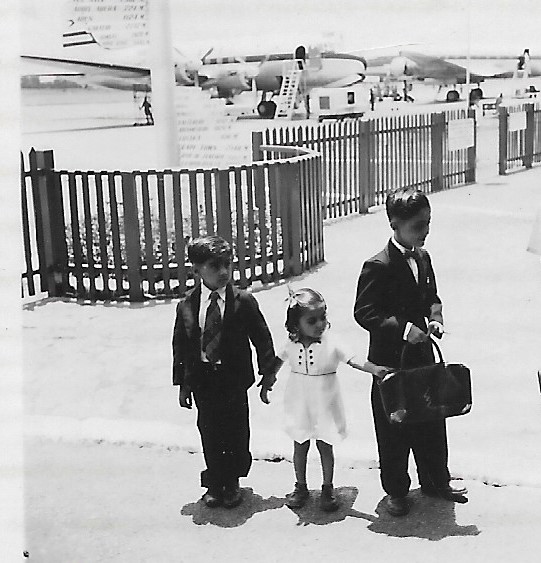
- The only tie in my time was a military green tie that was part of the uniform from class 5 to class 11. The ‘Guard Commanders’, Prefects and Drum Majors wore a black tie as part of the Sunday Kit but there were only a dozen or so of those. No other tie existed! Most people didn’t possess a tie of any sort let alone an ‘Old School Tie’. Very few people possessed blazers or jackets. The ties shown in the documentary only came into existence decades after I left. As it happens, I was one of the few who did have a personal tie and this is evidenced from my wearing it as an urchin photographed with my siblings on my way to school from Nairobi Airport (see photo below)
- A little girl utters nonsense including ‘The tie is honoured especially outside school; you are treated as someone superior….represents correct attitude to life’. Who exactly is she referring to that are honouring the tie and treating the wearers (i.e., old Lawrencians) as someone superior?
- The documentary claims ‘In 1858 the school was established for the children of British Soldiers serving in India’. Nonsense! The institution was established as an asylum for the orphans of both East India Company and British Soldiers provided that both parents of the orphans were Europeans and Christian. Sir Henry Lawrence was an East India Company official.
- Sonal Bhatia Head Girl says ‘the military traditions we follow is an advantage because it teaches a lot of discipline’. Utter rubbish; it teaches acceptance of violence from characters like prefects, house captains, monitors etc. That sort of violence would, in this day and age result in severe retributive action outside the cocooned environment of Lawrence School where thugs can inflict gratuitous punishment and beatings on those weaker and younger than themselves.
- Headmaster Lahiri talks about ‘success in life is to do with pressures and the kind of pressure we put on a child here’. He also mentions ‘baptism by fire and you land on your feet’. No sir, most people come out of the institution no better than any local school in terms of academics and as mediocre in the fields of sports etc. The major difference is that hard working parents are out of pocket without any extra gain.
- In the documentary we hear 3 pieces of music by the school band: ‘When The Saints Go Marching In’ (based on an old gospel song; not appropriate for a secular school), Daisy Daisy (based on Daisy Greville, Countess of Warwick, one of the many mistresses of King Edward VII and part of ‘The Marlborough House set’ This ‘set’ enjoyed horse racing, hunting, shooting and playing cards. They often visited country houses for weekend-long parties, at which adultery was common). As it happens this is one of the songs taught to me as a 6 year old by my Anglo-Indian teachers. Finally, the band is marching to ‘For Auld Lang Syne’. These words are in Scottish Gaelic and literally translated mean ‘For Old Long Since’ which today can be interpreted as ‘For Old Time Sake’. Once again, as it happens, it was a tradition within Nilgiri House where I was a pupil for 4 miserable years, to render this song on the last official day of school before the non-ISC boys left for home. The tradition was introduced by Anglo- Indian McMahon the Housemaster who probably learnt it in the Railway Colony he came from. As soon as the song was sung, which was early evening, Mac would be off to the Lawley Institute in Ooty as there would still be many hours of gambling available!
From my experience commencing the beginning of 1958 when I joined as a 6 year old to the end of 1968 when I left, it was obvious that this clip was entirely bogus. To start with, and I repeat, there was no such thing as a School Tie! The only tie which we had was a ‘military’ green tie given from standard 5 onwards. The ties shown in the clip came into being many, many years later! There were no groups/structures/set-ups jumping at the chance to help Old Lawrencians! There were groups of friends formed by alumni of the same year or same house etc. but these were and are no different from such friends’ groups formed in any other institution. Lawrence School Lovedale didn’t instil any attribute that was different from any other educational institute. On the contrary, the bullied have a deep seated resentment towards the bullies and the enablers (such as K I Thomas the Headmaster and Mac the overhyped Housemaster). This resentment manifests itself by the fact that, despite huge gatherings of alumni of particular years, most school leavers do not ever return to that den of iniquity!
Before proceeding let me say that I know the main Old Lawrencian speaker, Jit Chacko extremely well. His youngest brother Harsha is my friend and was both, my housemate and classmate. Another brother Jacob is my brother Naren’s friend and classmate. There was yet another brother called Jay who was also a friend, albeit he was much senior.
To expose the bogocity of the clip, I can do no better than set out extracts from ‘With a Little Help From my Friends’, a book written by the same Lahiri published 23 years later, long after he was given the bum’s rush from Lawrence School Lovedale.
Extracts from the chapter ‘Beneath the Beauty’ of Lahiri’s Book With A little Help From My Friends:
In the midst of all this martial ardour, a very sickening tradition, masquerading as part of the military ethos, had crept in. That was bullying. The seniors thought it their God given right to hit juniors with hockey sticks at the slightest excuse, so much so that bones were broken on a regular basis. The worse sufferers were the students of class 9 which was the junior most class in Senior school (classes nine to twelve). In the Middle school (classes seven and eight), students of class eight bullied those of class seven. The Prep School (classes four to six) was not afflicted by this tradition, and neither was the Girls school (the boarding where all the the girls resided).
Among the boys there was a codified system of favours by which seniors could ask a junior to do anything for them at anytime. Each class twelve student had a ‘Piza’. This was a title sanctified by tradition denoting the equivalent of a personal slave. I came across Pizas sneaking across the campus in the dead of the night to fetch clothes for their masters from the dhobi-ghat which was located at one end of the campus. Often Pizas had to sit by the bed of their master to wake him up at the appointed hour. Failure to live up to the senior’s expectations invited serious retribution. There was at least one case of a boy being branded with an electric iron!
One particular incident will haunt me till the day I die. I was about three months into my tenure when one morning an enraged mother of a class seven boy stormed into my office. She took off her son’s shirt and showed me huge red welts on his back. The boy had been systematically thrashed in the night by the boys of class 8 with wet towels. His fault? He had dared to defeat a boy from the class above in the finals of a prestigious school tennis tournament called the ‘Rob Roy’ tournament, ironically sponsored by a well known alumnus.
The mother’s word still ring in my ears, ‘I may be able to cure the scars on his back but what about the scars on his soul?’
As I started to spend time with the boys, I realised that they were not the savage vicious creatures one might expect them to be, especially in view of the horrific incidents of bullying the the campus kept witnessing. On the contrary they were courteous, well-mannered and all from very respectable families. There was obviously something wrong with the environment they were in. This observation started giving me some insights into how to tackle the bullying problem.
It is my view that not only is bullying completely morally reprehensible, it also creates an atmosphere of fear that stifles creativity. Not only are the victims often scarred for life, but whilst at school they are unable to achieve their potential as they spend the better part of their best years covering in fear. In my view as Head of school, I owed it to every child entrusted to my care to provide a level playing field so that all could grow and explore their talents and strengths with a sense of joy and abandon.
Bullying was not the only problem staring me in the face. One of the problems that plagues our education system in general and the public school system in particular, is the woeful shortage of good teachers. It is a sad fact that most of those who opt for teaching, particularly in remote boarding schools, rarely do so as a first choice. The head of the school very rarely has the privilege of being able to choose from a large catchment area of trained teachers, in the same manner that a corporate head does, in terms of his personnel requirements.
Whilst Lawrence School was singularly blessed in some of the teachers it had, it too shared the problem endemic to most residential schools. The fact that this body was seriously fractured, only added to my woes. Some suggested that it was a Tamil v Malayalee problem. Being from North of the Vindhyas, I was blissfully unaware of this divide, which was just as well because it allowed me to ignore these divisions even if they did exist. The better teachers in the faculty seem to have been thoroughly deflated by the indiscipline that prevailed in the school. Most felt threatened by the senior boys and with good reason. Private property such as scooters and cars were frequently vandalised, particularly if a teacher reported an act of indiscipline to the authorities.
Then there was a problem of a near complete breakdown of administrative procedures. Almost as soon as I had taken over, the District Forest Officer (DFO) called me up to inform me that someone involved in School security was selling timber from the school forest. The kitchen staff could load as much food as they wanted in their ‘tiffin carriers’ and take it home. This resulted in them cooking much more than what was required for any given meal. All that was left over was theirs for the taking! Every single department suffered from some such serious infirmity.
The infrastructure was in shambles. The school went without electricity for days at a stretch particularly during the monsoons as there was no generator backup. The toilet for the senior boys called ‘Big Bogs’ was my idea of what hell must be like. One visit there was enough to make me want to throw up. The gymnasium was a shell of a building with virtually no equipment. There were no decent tennis courts. The list was endless and to my mind this was a backdrop to the atmosphere of indiscipline that prevailed in the school.
An incident at Lawrence School Sanawar, sister school of Lovedale made headlines in 2009 and was reported among others by the news channel NDTV. See my reaction:
My letter to NDTV in 2009
Your news item about the ‘ragging’ incident at Lawrence School, Sanawar was shocking enough. What was more shocking and and an absolute disgrace was the interview given by a parent called Haneela Bajwa whose son was one of the victims.
This Haneela Bajwa character is undoubtedly the worst parent in the world. She virtually gave ‘cart blanche’ for such incidents to be repeated by claiming that:
1. A bit of ‘drilling’ is expected by the senior boys on the junior boys and that is what a boarding school is about
2. The school was right in taking the action it did by sending the boys responsible home and
3. That she would not want any further action taken against the boys responsible other than counselling.
Let me tell Haneela Bajwa that:
1. A bit of ‘drilling’ should not be expected; what do schools employ masters/mistresses for? Any ‘drilling’ must surely be under strict supervision. Her statement that ‘that is what a boarding school is about’ is as stupid a statement as I have ever heard.
2. The school authorities who took the decision to send the boys home should be charged with aiding and abetting the criminals. The act commited was criminal and should have been reported to the police and it should have been the police who handled matters from there. The school authorities had no business taking the law into their own hands.
3. ‘Counselling’ is the last thing these characters need. A spell behind bars be it in a ‘youth’ jail or indeed an adult jail would be more appropriate.
Comment was made that some parents did not wish to pursue matters as one of the offenders was the son of a police officer in Punjab. Is this what India has come to? Not only are children bullied at school but their parents are also bullied by the parents of the bullies.
The police officer must see to it that his son is charged with ‘assult and battery’ as otherwise he is negligent in his duties as a police officer of the nation and must be dismissed immediately.
The Head of Lawrence School Sanawar must immediately be charged with Criminal Negligence as this incident happened in his ‘watch’. When parents send their children to school the masters/mistresses are expected to act ‘in loco parentis’ (in place of parents) and clearly in this case they did not.
I do know what I am talking about. I was a student in the sister school, Lawrence School, Lovedale for 11 years from the beginning of 1958 to the end of 1968. The headmaster there, K I Thomas let the seniors bully the juniors to such an extent that even to this day, people think that is a normal form of behaviour. My brother and sister also went to that school and it is deeply concerning to note that such boorish behaviour is the norm. In all of the years I was there, not once was action taken against any boy for bullying! Indeed one of the masters, McMahon victimised the victims of such bullying! You can mention both these names as the masters concerned have both died, thank God! I would mention that one of my school mates was an owner/former owner of NDTV!!!! (Note from Jitu Savani: the late Narayan Rao, not quite owner, was CEO of NDTV and my school mate. We were in the same ‘Guard’ for Parade).
The ‘ragging’ as news channels refer to is really bullying and criminal assault/battery. It is a legacy of the British system. The British left 60 years ago. Are we not capable of having Indian systems in place which do not include such behaviour? Ironic though it is, ‘ragging’ does not exist in Britain. Any perpetrators of such behaviour would be arrested and charged. Nobody would be frightened just because one of the parents happened to be a police officer!
I could go on and on and even point out a prominent industrialist who wants nothing to do with Lawrence School Lovedale, such was the climate of bullying. However, I doubt you would in the least bit be interested.
With kind regards.
Jitu Savani
Now see Dev Lahiri’s Article on the same incident:
It was an education to see the sad occurrences at Lawrence School Sanawar, and just prior to that, the Aman Kachroo case managed to grab the TV and newspaper headlines. What was sadder is that the public conscience is outraged only now that the media has bombarded us relentlessly with this news. Did events like this not occur earlier? Were our schools and colleges safe havens prior to these incidents?
When I took over a school in 1991, I found that it was commonplace for senior students to entertain themselves by hanging little boys out all night from the first floor windows, to break their arms with hockey-sticks and to proudly autograph the plaster cast, to brand their slaves with electric irons — all in the name of tradition. And this school was being run by the HRD ministry! I had to wage a battle to combat this menace. There was a large section of the alumni which felt that I was diluting the character-building ethos of the school. So, what are the remedies, if any?
Any attempt to answer the question must first make a distinction between bullying and ragging. Incidents of the nature I have described are tantamount to bullying. This is the kind of sadistic behaviour displayed by a senior boy (or a group of boys) in order to give sanctity to the pecking order, particularly in old boarding schools. Over a period of time these sadistic practices become part of the hallowed traditions of the institution.
Bullying in day schools tends to be different. In a day school, it’s less of a cultural thing and more of an individual or gang-related phenomenon — either a powerful individual attracts the support of a gang of admirers who then proceed to prey upon the weaker ones, or there is a proliferation of gangs who fight each other over different issues (in a coed school, for instance, mainly over the attention of girls).
It may seem that bullying is purely a male phenomenon. However, nothing could be further from the truth. There is a great deal of bullying among girls as well — albeit of a different kind. Girls will not indulge in physical violence, but their bullying takes on far more subtle and psychological dimensions.
Ragging is different — it’s a sort of initiation-rite practised in colleges. It was fairly prevalent in the US and was known as hazing. It drew its inspiration mainly from the harsh practices of US military academics, meant to toughen would-be officers. These rites of initiation, which can range from the ludicrous to the sadistic, do not usually last very long, and are terminated after a welcoming ceremony which is held a few days/weeks after the opening of the new term.
The freshers are then regarded as regulars. What happened at Lawrence School Sanawar belonged to the first category (bullying), and what happened to Aman Kachroo belonged to the second (ragging). Both practices are evil, insidious and destructive, but there is a distinction, nonetheless.
In TV debates many experts claimed that most bullies are from maladjusted family backgrounds, and had probably suffered some deep emotional scarring in early childhood. My experience has been quite to the contrary. Most of the bullies I have dealt with have been from perfectly normal and happy backgrounds, and carried no emotional baggage.
So where do things go wrong? Well, the answer is partly societal. We are quite simply, a nation prone to bullying. Our caste system is perhaps the most sophisticated attempt at legitimizing bullying. Children learn to bully servants from a very early age. If we happen to occupy a position of authority or influence or wealth, we encourage our children to flout rules, and then flaunt our authority when they’re caught in the act. We use bullying tactics by approaching friends and relatives in high places to secure admission in institutions, or even jobs for our kith and kin.
At a very basic level, what happened to Jessica Lal was the ultimate tragic consequence of an act of bullying. We behave in foreign countries only because our bullying tactics do not work there.
The role of parents, therefore, has to be seriously evaluated. What kind of role-models are they at home? What is their reaction when their children do something horribly wrong? My own experience tells me that many parents when confronted with something wicked their child has done, just go into denial, or worse, into outright aggression.
The biggest challenge for schools is to provide an atmosphere that is free of fear. They must create an ethos and an environment where the persecuted can speak out. A clear message must go out that certain forms of behaviour are just not acceptable. There will be times when harsh decisions will have to be taken. In our country there will inevitably be pressures — political, bureaucratic and others — but an institution has to stand firm.
The other pillar of the crusade is vigilance. No institution can afford to let its guard down in the mistaken belief that it has permanently rooted out the evil, because this pernicious practice has a way of creeping back. Staff must be trained to look out for the first tell-tale signs — dropping grades of a hitherto good student, an apathetic attitude, sullenness that indicate a brewing problem.
Bullying can often be the product of boredom — the pursuit of an unchallenged mind. Institutions that provide their students with meaningful activities, intellectual and physical, are more likely to avoid this curse, than those that do not. Schools have today become so obsessed with marks and tuitions, of sending as large a contingent as possible to IITs, that the good old business of school teaching in its most complete sense, of imparting values in the classroom, has totally fallen by the wayside.
Bullying is not going to be eradicated by a Supreme Court edict or a Presidential decree. It will require the active cooperation and engagement of all segments of civil society, if this evil is to be wiped out.
So all this business of Old Lawrencians forming close knit communities ready to help each other is a load of tosh! The victims of the criminal behaviour set out above would breed resentment rather than camaraderie!
Mr Lahiri died at the age of 70. His own book exposed the bogosity of his highfalutin spiel on the video. His work against the odds to wipe out bullying was commendable. However, his hypocrisy must also be exposed: He was a very close friend of K.C. Jacob who he met at St Stephens, Delhi where both were students. I can say from personal experience that K.C. Jacob was the vilest of bullies when he was vice-head boy in 1966 and indeed he would occupy a place on the top table of bullies since the inception of the school. Lahiri was headmaster when K.C. Jacob’s two daughters were at the school. Jacob was the big chief of the PTA and was ably assisted by Lahiri. Not just that but Lahiri gave special attention to the said daughters and enabled them to get scholarships to study abroad. Whilst I have never met them, I am sure the daughters are and have always been ladies but Lahiri should have kept his distance from K.C. Jacob!
The other matter that Lahiri deserves criticism for is his obsession with equestrianism. This is a very expensive sport and would certainly not be affordable even by the super-rich once they leave school. Indeed it isn’t affordable in most Western countries! There is no tradition of this sport in the school before Lahiri introduced it. There have been riding lessons in school and indeed I was among the privileged few who availed of this facility. However, there were only half a dozen or so elderly horses that would have been put down in the West. Retired Army horses was the source of the stock of horses when I was there. Now, the number of horses, their maintenance, the staff employed and the space occupied by these equine beasts is out of all proportion to any benefit that ensues to any student. Even the accoutrements for the purposes of the sports would be unaffordable to most students. However, since Lahiri introduced it, it has become ‘an old Spanish custom’ that nobody has the courage to do away with. Whilst competitions may well be won in India, the bar there is woefully low!
Lahiri was totally dishonest with reference to the manner in which he dealt with finances relating to his obsession with horses. He would purchase horses of his own accord from sellers of his own choosing notwithstanding that he had no expertise in such matters, he would try and hide the purchase cost under running costs, he would send his daughter to an event by air and then claim it as an expense occurred under some other heading, he even claimed for transporting horses by air!
There has, in my opinion been one incident involving a school horse that is worth mentioning. A thoroughly corrupt retired babu, Sivaraman, who had become Chairman of Governors availed the use of such a horse to ride for his personal pleasure. The horse quite rightly dumped the babu on his derriere. The school jeep, rather than the school car was sent to cart the babu with the sore bum to the hospital. The babu was apoplectic with rage, thinking his posterior deserved a more comfortable journey. This was one of the factors that resulted in Headmaster Ramesh Venkateswaran being obliged to resign.