See also the despicable part this character played in the First War of Independence in my Page: First War of Independence and Aftermath

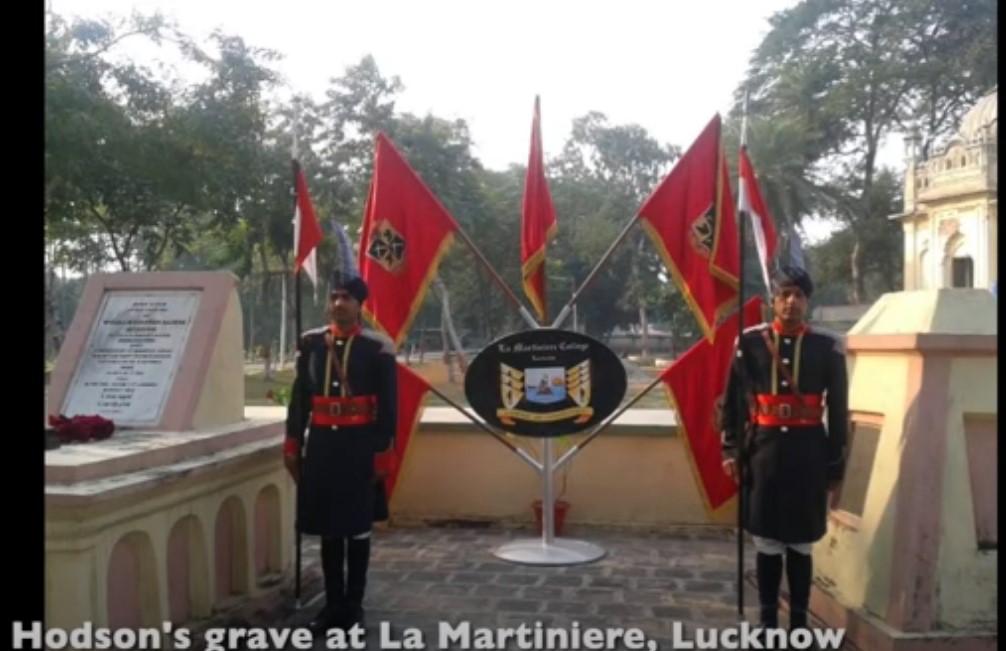
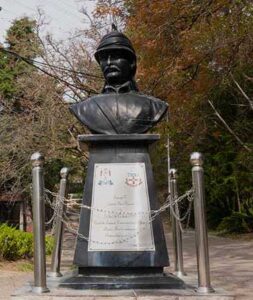
Astonishingly, this villain is still honoured by Lawrence School, Sanawar. Hodson was educated at Rugby School under Thomas Arnold and at Trinity College, Cambridge.
Whilst for the British he was a hero, to Indians he should be regarded as a villain, particularly as far as his propriety in financial dealings is concerned. It is ironic that all three Lawrence brothers had doubts about his integrity and the extract following the photos below, from Wikipedia is instructive on just how questionable his honesty was:
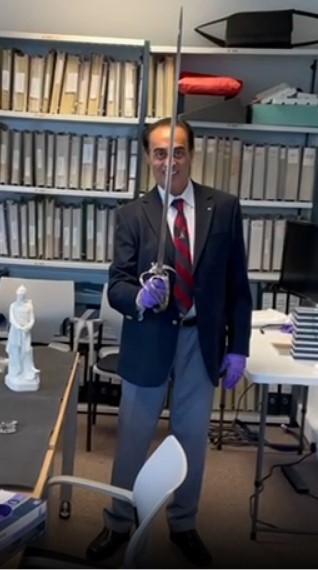
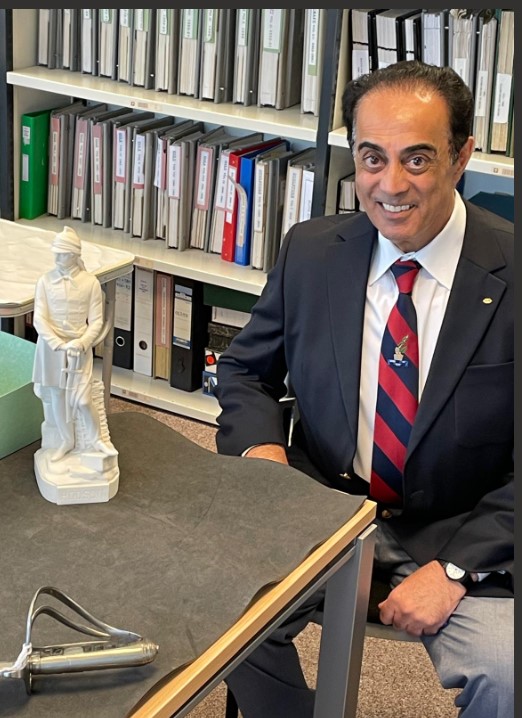
Below are photos of Jitu with Hodson’s sword and also a close up of Hodson’s statue, both items held at the National Army Museum, UK
Accusations of corruption
In 1855, two separate main charges were brought against Hodson. The first was that he had arbitrarily imprisoned a Yusufzai Pathan chief named Kader Khan, as well as his young son, on suspicion of being involved in the murder of Colonel Mackeson. The man was acquitted, and Lord Dalhousie removed Hodson from his civil functions and remanded him to his regiment because of his lack of judgment and gross negligence.
The second charge was an accusation of misappropriation of the funds of his regiment. He was tried by a court of inquiry, who found that his conduct to natives had been unjustifiable and oppressive, that he had used abusive language to his native officers and personal violence to his men, and that his system of accounts was calculated to screen peculation and fraud. However, a subsequent inquiry was carried out by Major Reynell Taylor: “Taylor’s investigation took two months, during which time he went through every item received or paid out by Hodson over the two years of his command”. By the end of his investigation into the record of Hodson’s accounts Taylor found “…it to be an honest and correct record from beginning to end. It has been irregularly kept, but every transaction, from the least to the greatest, has been noted in it, and is traceable to the individuals concerned”.
During a tour through Kashmir with Sir Henry Lawrence he kept the purse and Sir Henry could never obtain an account from him; subsequently, Sir Henry’s younger brother Sir George Lawrence accused him of embezzling the funds of the Lawrence Asylum at Kasauli; while Sir Neville Bowles Chamberlain in a published letter says of the third brother, John Lawrence, 1st Baron Lawrence, “I am bound to say that Lord Lawrence had no opinion of Hodson’s integrity in money matters. He has often discussed Hodson’s character in talking to me, and it was to him a regret that a man possessing so many fine gifts should have been wanting in a moral quality which made him untrustworthy.” Finally, on one occasion Hodson spent £500 of the pay due to Lieutenant Godby, and under threat of exposure was obliged to borrow the money from a local banker named Bisharat Ali through one of his officers.[1]
Financial matters
Throughout his career Hodson was dogged by accusations of financial impropriety. He was investigated on more than one occasion but nothing was ever proved. His detractors claim he was a looter; his supporters say that these accusations came from those who disliked his manner and his military success. William’s brother, the Rev. G. Hodson, stated in his book that he obtained the inventory of William’s possessions made by the Committee of Adjustment and it contained no articles of loot, and Sir Charles Gough, president of the committee, confirmed this evidence. This statement is incompatible with Sir Henry Daly‘s. Sir Henry Norman stated that to his personal knowledge Hodson remitted several thousand pounds to Calcutta which could only have been obtained by looting. On the other hand, again, Hodson died a poor man; his effects, which included a ring, watch, Bible and Prayer book, and a miniature, were sold for only £170.[1] General remarked “there was nothing in his boxes but what an officer might legitimately and honourably have in his possession. His widow did not have money enough to pay for her passage home and she had to apply to the Compassionate Fund for assistance, which was granted.
It is absolutely astonishing that this character who can at best be described as a scoundrel is honoured to this day by having an annual event named after him!