Reminisces of my friend Derek Gaw Old Lawrencian of 1947 Batch
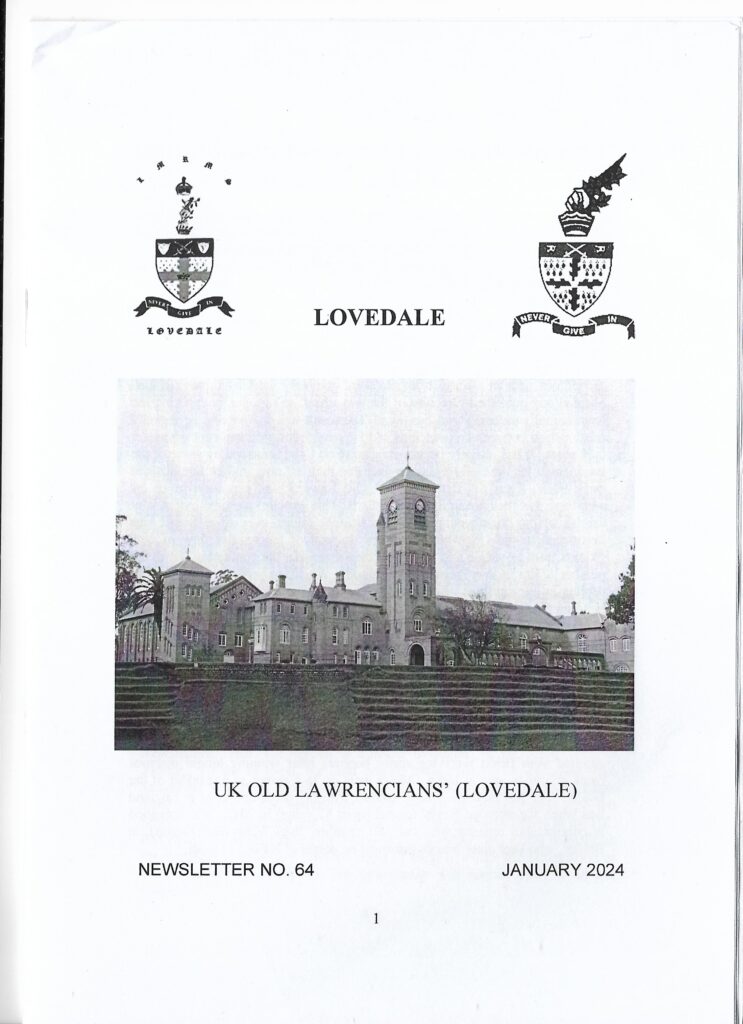
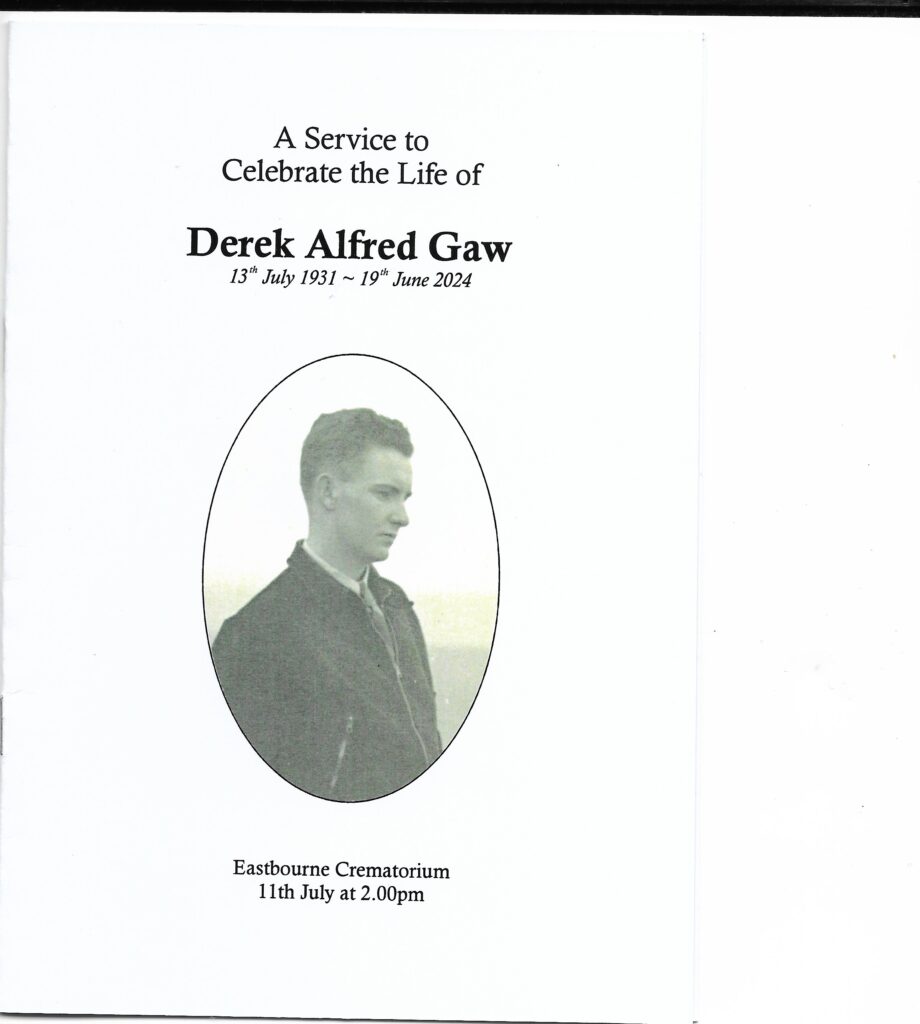
The Late Derek was my friend here in the UK for 30 years. He was still in love with the school and India in general until his dying day. He made many more trips to India than I made and he met many more Old Lawrencians in India, many more Academic Staff, both serving and retired than I did and he was far better informed about events in Lovedale than I was. This post gives valuable glimpses of the History of the School not recorded anywhere else. It is a short summary of the transition period from a British School to an Anglo-Indian school. As late as 1950, 70% of the students were Anglo-Indian. For many years Derek produced the UK Old Lawrencians (Lovedale) Newsletter containing news about Old Lawrencians from all over the world, particularly UK and Australia, see below cover of the January 2024 newsletter and also the notice of the funeral service which I attended.
Dear Jitu,
I recall two boys named Vembu arriving at school at the end of 1946 /early 1947, but they do not appear in the Admission Directory in my possession. They could well have been Day Scholars.
I remember notice being taken of the arrival of an officer in the French Administration. The father was white, but all the boys were dark skinned with very English forenames. I know that one (or more) of the boys turned up later in Australia.
Humayun Dhanrajgir is shown as arriving at School on the 10th June,1947, but I cannot recall any knowledge of him doing so. I suspect the answer is that he was admitted to our separate Kindergarden or Junior Boys school.
Karimullah Sheriff is recorded as arriving on the 23rd February, 1948.
The most significant admission of Indian pupils occurred after I left Lovedale at the end of 1947, with the arrival of several members of the Reddy family starting with 4 pupils on the 2nd March, 1948, with several others following.
As you are probably aware, the Lawrence Schools were originally aimed at providing a home and education for orphans of servicemen killed / died while on duty in India. When the Lawrence Memorial School in the Nilgiris first admitted pupils at Ooty, the number attending was very low. The School only really got under way in the 1880s after the buildings at Lovedale allowed for their transfer. Early on until beyond World War 1, admission was restricted to boys and then girls under 12 years of age. The restrictions lasted until the age barrier was lifted in the late 1930s. During my time at School there were many coloured children – one boy ahead of me had been given the nickname “Moonlight” because of the colour of his skin. There were many other similar cases, including the Thompson brothers and Mrs Prince, the Bandmaster’s wife , who hardly ever appeared on any particular school occasion. The likes of the Bamfords and Natalls were now “part of the scene”, with marriages between soldiers, etc. with local girls a common experience. We just got on with life at school as it was, “mixed marriages” hardly featuring in our thinking
The majority of pupils were from generations of Europeans ( U.K mainly) who stayed on by choice in India – in the Forces, Railways or Government positions in the Post Office, etc.
I cannot say I remember anything about a Mr. Blazey and my remembrances of “Sargy” Nicholls have sadly become rather dim. He was ‘fit and alive’ and significant as an Instructor with much influence in the lives of the boys when I left at the end of 1947. I did not hear of his demise until many years after the event , along with information that Mrs Phillips had been kind enough to care for him. We made a point of visiting his grave in the School’s Cemetery to pay our respects on our visits to Lovedale over the years.
The Principals were usually Church of England Priests from England. The Staff consisted of men and women drawn from the “English” community (a few not properly qualified) with the first Indian teachers arriving in 1946. Not many stayed for two long but, one a Mr Lewis, suspected of being an Anglo-Indian, stayed on as a bit of a tyrant as an English Teacher. He was to provide my first lesson in life when he, during the last week-end before the end of the School Certificate Examination, gathered some candidates (boys-not girls) to present them with a list of likely of questions he had sorted after a serious study of past English papers. I and some others had been allowed to return to our families on Saturday until Monday morning to prepare and help for our exit. When we returned, colleagues informed us of what had occurred and updated us “at the request of Lewis”. Only problem was that there was no time to do anything about it and some easy reading books were in the hands of others. We had to believe that Lewis was only guessing – until the paper was presented to us … word perfect !! The shock was manifest among the unlucky few, but life at that time did not allow for squealing. Honour and trust became a question for me and led me to believe that “if anything in this life could go wrong it would” ! A wonderful aid to me in my later life, especially on inspection as a manager. I never saw Lewis again as within 2 days I had joined my family at Wellington and was on my way to Deolali and the U.K. – not having contributing to Lewis’ winning prize of 100s of cigarettes from his audience while in-between his duty as the invigilator at Breeks School in Ooty ! I did not hear about him again or whether he had succumbed to tobacco (or smoking) problems !

In the photo above, seated first left is Walter Fletcher, aged 96, next to him is Derek Gaw aged 92, next to Derek is my friend Paul Sabapathy of the 1957 Batch, and sitting first right is Neville McLeod. The photo was from the Old Lawrencians, London Lunch held in 2023, the last one attended by Walter and Derek.
To sum up, right up to the arrival of Humayun Dhanrajgir, there were no pure Indians but there were a few Anglo-Indians. The first Indian teachers arrived in 1946. The Anglo-Indians arriving after WW1 is not surprising. In Shashi Tharoor’s well researched book, Inglorious Empire, he states that all the staff in the Railways were white and it was only when the Whites had to go fight in WW1 that Indians were allowed to work. But not just any Indians; they had to be Anglo-Indians! Hence Lawrence also started attracting Anglo-Indians in the late 30s early 40s!
Here is how matters were progressing: The Bandmaster mentioned was Mr. Victor Prince. He stayed on in the school until the late 60s. The Mrs Prince mentioned, an Anglo-Indian died and is buried in the school cemetery but not before producing children who I came into contact with: Denzil who became the Bandmaster himself, (I was briefly in the Band when he was its master), Barbara a beautiful lady who was my prep school teacher, Dorothy who I never met and Francis Llewelyn (Bobby) who was a year my senior. Victor Prince then married another Anglo-Indian called Magdalene Beal who produced two children, Winston and Christopher who were my juniors. Magdalene Prince was my teacher in Class 5. Victor Prince was well past retirement age when he left with Magdalene to emigrate to Canada. He played in the band, wearing a Prefect’s uniform until well into his 60s and on his last day was invited by Headmaster Thomas to make a farewell speech. That was the first time I heard him speak. It was with a Cockney accent; I could recognise it as I had spent a few months in England in 1962.
After Independence, there should have been but there wasn’t a wholesale removal of the vestiges of British rule. For immediately after Independence, a large contingent of Anglo-Indians occupied prominent positions. For example, Mrs Coehlo was Headmistress of Prep School, a Mr Gonzaga was Housemaster of Nilgiri House, Mrs Enos nee Cunningham was English teacher at Prep School, Miss D Stokoe (later Mrs Smith) was a teacher in Prep School, Mrs Fowles was the Prep School steward, Mrs Parker was the matron in Girls School, Dr Shaw (who was a Prisoner of War taken by the Japanese) was the school doctor, Mrs Richter was the school nurse, Mr Roland was the cinematographer, and there were many others. Most would not have any interest, understanding, sympathy or empathy towards a small Hindu boy thousands of miles away from his home and his parents.
Thus, little Hindu boys who attended were, right from the start turned into pliable, exploitable souls whose role models were neither British nor Indian and were thus subject to being converted into individuals who hated their own nearest and dearest! A complete achievement of Bishop Vital Grandin whose quote (said in a Canadian context) is as follows:
We instil in them a pronounced distaste for the native life so that they will be humiliated when reminded of their origin. When they graduate from our institutions, the children have lost everything native except their blood. Bishop Vital Grandin 1875.
Known to me since 1997 Mr. Derek Gaw, was one person i will never forget in my life. We as a family dearly miss such a wonderful and intelligent human being.
Best,
Prabodh Badoni and family