Please also see my Page : School Reports sent to British Army : and within that Abysmal standards of toilets/latrines/lavatories
Never be misled by the magnificent looking buildings. The outer buildings concealed the slum conditions inside.
Even when it was an all white school, the internal infrastructure was abysmal. Here is what Derek Gaw, admitted as a pupil to the school on 22 June 1939, one of the last Britons (as opposed to Eurasians/Mestizos/Anglo-Indians) who completed their secondary school education in Lovedale c.1947 said to me: ‘The toilets facilities were very basic. In the main building there was an extension leading down the hillside for daytime use and, at night etc. a facility was available with a few “seats for business” with buckets beneath and separate buckets for urinating. House Dormitories were filled by age groups in my day and the boys well knew what they had to do If ‘caught short’ during the day or when out in the field.’ In other words, not only was the shit collected manually, what in modern day India is called ‘scavenging’ but open defecation was also common! The ‘extension leading down the hillside’ was later to become the infamous ‘Big Bogs’.
I spoke to my friend Hy Money who , as Hyacinth Daniels was admitted to the school on 11 February 1942. At the time of her admission, the girls school was located in what later became Prep School (which I joined). In her time, there were girls divided in 4 houses and all had to use the one set of ‘toilets’ located where in my time the Standard 4 boy’s toilets were located. These toilets were styled like the old Roman toilets where girls sat next to each other. There were no flushes but water flowed below sporadically to clear the shit to God knows where! It was a frightening experience for any girl from a ‘house’ located a distance away from the toilet to ‘go’ at night particularly as the lighting was very poor indeed. Thus bed-wetting was a frequent occurrence among the girls. (Note from Jitu: As is documented relating to sister school Sanawar, the toilets were barrack style, see illustration that follows the photos.)


These were the type of toilets in use up to and beyond Independence; no privacy whatsoever.
Coming now to the post-Independence era:
The school was divided into Prep, Junior and Senior. There was a separate girls’ school. One can begin though, by stating unequivocally that in all parts the facilities were dreadful. Not surprising as throughout the 11 years I was in school, not once did I see the Headmaster, K.I. Thomas, much vaunted and still revered as a God like figure decades after his death, anywhere near a toilet, bath/shower room or dormitory. In fact, he rarely left his luxury residence.
In the four years I was in Prep School, he only visited once and that too on the outside when he came as part of an entourage to accompany a couple of tiger cubs that had been shot on school premises and were being shown to all the children. That was in 1959.
I never ever saw him at Junior School in all the three years I was there
In Senior School, he did take one assembly a week, so visited the assembly room and in this assembly room were also held such ceremonies as prize giving, swearing-in, and other similar events.
The only classroom he visited was where he held his one lesson a week.
He had to be present at ‘Top Flats’ where the annual parade was held as it was his job to accompany the chief guest. There were a few occasions where his presence was required, for example, to see a final match of the inter-schools tournament.
He did sometimes have lunch in the dining room in the Senior School but that was, at most, once a week. Thomas’ mystique (defined as ‘a quality of mystery, glamour, or power associated with someone or something’) enabled him to get away with totally neglecting the crumbling infrastructure. This ‘mystique’ was added to by the fact that the only time most boys saw Thomas was when he took a lugubrious walk from his job related luxury mansion to his office, a distance of around 150 meters where only the last 50 or so meters was visible to anybody who happened to be present in the area. He inherited what the British left and either he or his predecessors (Bhan and Lakhani who between them served 3 years post 1947 before Thomas took over in 1950) made a few haphazard changes such as replacing western toilets with Indian toilets. There was a terrible water shortage and Thomas’ idea of dealing with this was to shut school a few weeks before end of term and have pupils eat from one plate the different food items served (e.g. soup followed by rice and curry from the same plate followed by pudding on days when fruit (one measly banana/pear/orange) wasn’t served. Certainly Thomas was in charge when the dreadful ‘Junior School’ was ‘constructed’ towards the end of 1961 by converting a few outhouses, which under his headship had been condemned half a decade earlier, into a formal junior school. So ill thought out was this construction that there were no cooking facilities for the junior school, the food had to be carried from the Senior School, there were no hot water facilities, that hot water was connected to the boiler room in the senior school via a led pipe.
Here is an extract from the speech given by L.A. Vyas at Founder’s Celebrations in 1983 relating to the ‘outhouses’ that passed off as the junior school: ‘ Later, the Junior School buildings, which have long outlived their utility to let you into a secret, these buildings built of mud and bricks with lime plaster were to be demolished in the mid-fifties-will be pulled down and rebuilt. The parents of the Junior School know that the facilities provided there are, if not the very last, a good second-last word in discomfort.’
Absolutely nothing happened for decades! Indeed, in the years 1958 to 1960, both years inclusive, art and craft classes were held in those ramshackle buildings; I know! I was in those classes! In the years 1962/3/4, I was a resident of those buildings which had become slums! In the year 2003 when on a visit for a re-union, there was still no change other than the toilets stank even more! It was only in 2008, more than 50 years after the buildings were to be pulled down that actual work began!
Many decades after I had left school an old classmate and friend of mine, Viju Parameshwar told me that an enquiry had been made as to why, despite the abundant rainfall there was always a shortage of water. The answer was simple: pipework laid down by the British was crumbling! Surely, Thomas could have initiated the same enquiries! But he was far too lazy.
One would think that the beautiful external appearance of the premises would be a reflection of the internal beauty and architecture. That would be as far away from the reality as possible!
Let me quote from the book ‘With a Little Help From My Friends’ written by a Headmaster from the 90s Dev Lahiri. The book was written in 2016 but refers to the early to mid 90s when Lahiri was Headmaster:
‘The infrastructure was in shambles. The school went without electricity for days at a stretch particularly during the monsoons as there was no generator backup. The toilet for the senior boys called ‘Big Bogs’ was my idea of what hell must be like. One visit there was enough to make me want to throw up. The gymnasium was a shell of a building with virtually no equipment. There were no decent tennis courts. The list was endless and to my mind this was a backdrop to the atmosphere of indiscipline that prevailed in the school.’
There was no change a quarter of a century after I left that dreadful hell hole!
By far the most degrading aspect of school life was toilets. In all three parts of the school, Prep, Junior and Senior, they were all Indian style and no toilet paper was ever used. Following defecation, it was hand-washing bums with water. There should have been a wash-basin with soap to wash hands after that. However, in all the 11 years I spent there, there was not one single hand wash basin with soap to wash hands following defecation.
In all the parts of the school, there were many ancillary staff (servants) including cleaners, cooks, bearers, gardeners, ayahs, staff assigned to keep an eye on pupils, tailoring and kit staff. There was a huge contingent of clerical staff dealing with accounts, correspondence, complying with local laws and in addition, there were Gurkhas employed whose job was to patrol the large premises of the school (750 + acres) and ensure that no theft of wood took place (wood burning was the only manner in which servants and residents of nearby villages could cook). In all my 11 years, I never saw a single toilet for the use of such ancillary staff. So where did they ‘go’? It is still a mystery to me. I would mention that within the last few years, Old Lawrencians chipped in to make facilities available for such staff.
As far as the teachers were concerned, there were no dedicated toilets in either Prep or Junior Schools. So it is a mystery where they ‘went’! In Senior School, there were a couple of toilets for the use of teachers which was by no means enough. However, no soap and water there either!
So let me begin with a more in-depth look at the three branches of the school:
Prep School Toilets
There were 4 dormitories (including one for the girls) and each dormitory had use of several cubicles containing the toilets without doors or dividing walls for privacy. Thus it was the norm rather than the exception that 6 or so young children would be sitting next to each other defecating. One tap per set of cubicles had to serve all the toilets and one tin, generally a discarded Bournvita tin was passed around so that bums could be hand washed. However, there was a frequent shortage of water such that it was not always feasible to flush after each usage! During such times, water was ‘rationed’ and limited to one tin per bum-wash and shit piled in the Indian style toilet. Imagine the stench emanating from the cubicles and the gathered shit over which the next user had to shit! I recall quite clearly that one particular water shortage occurred just before the June holidays of 1958 (when I stayed back). I was still 6 years old! The gathered shit remained in the Indian style toilets until school resumed after the holidays (which lasted a month) as there was nobody around to clean the mess! Imagine the stench which young boys had to endure! Fortunately for the duration of those June holidays, we were shifted to the Girls school as only a limited number of staff stayed back. What was offensive to me even as a 6 year old was that Rosie ayah (see From Baby Krishna to Buchadkhana ) would arrive early in the morning when there would be the afore mentioned 6 or so boys defecating in the cubicles. She would simply occupy one of those cubicles, lift her saree, squat and defecate herself!
People may well say ‘that was a long time ago’. Well, I visited in 2003, 2008 and 2018. Hardly anything had changed! I made noises about this saying specifically ‘the bogs were not even bog standard’! A reply came from Anjolie Dev who happens to be an Old Lawrencian, who stated that the juniors were being toilet trained so that they cleaned up after they used the toilets.
Prep School Bathing
This consisted of one tub which was filled with some hot water brought by cans and mixed with cold water. There was no direct hot water connection. All of us little boys then had to strip naked and stand in a line, then proceed one by one to the side of the tub where we had to squat as if to defecate Indian style. Persuram or one of the other servants would then pour a large jug of water over each child, rub him all over with soap and this was followed by another jug to wash away the soap. An ayah (I still remember her name, ‘Nagi’ ayah) would then wipe us down. There were no individual towels in Prep School! That came when we went up to Junior School! There were no underpants either; just day-kit shorts. Indeed underpants came into use only when we turned 13 and in Senior School! After this ‘bathing’ off we would go to dress into our day-kit which included a ‘battle-jacket’.
Prep School Dining
The day started with sugary tepid water masquerading as tea brought in a aluminium can. Naturally we had to stand in a queue and we were served one bun with the alleged tea. There were not enough mugs to go round so a bucket of warm water would be kept at one side such that after one boy finished his tea, the mug would be passed to another who would dip it in the water and get his tea. At the end of this, the bucket would resemble a container filled with gutter water and the tea would be undrinkable.
Breakfast, lunch and dinner would be served in a dining room where a vile English remnant, a Mrs Fowles (see my Page Mrs Fowles and I) was in charge. The less said about the food the better as it was rubbish! There are two incidents that come to mind. The first was when a fly fell into my porridge and I decided not to eat it. Mrs Fowles was delighted in finding an opportunity to give me a few tight slaps and I was forced to consume the polluted muck. The only reason I didn’t throw up was that I feared a more severe beating! The other incident relates to the first three days when I returned to start my second year. Mrs Fowles assigned me to a non-vegetarian section. She claimed that my father hadn’t written to the school saying I was vegetarian. Either she was far too stupid to realise that the previous year I was vegetarian and, as a 7 year old couldn’t have changed, or she was being vindictive; I believe the latter was the case! I had never, ever and neither had any member of my family or indeed community ever eaten meat, and that too, going back to the stone age! I am still a vegetarian! So for three days, I would eat just the rice and leave out the meat curry that went with it praying that Mrs Fowles wouldn’t notice. Thanks to the intervention of a Miss Hari, a teacher who happened to be vegetarian and who remembered me from the previous year, I was transferred to the vegetarian table. Supper in the evening consisted of something that I thought was called sydish which was served with bread. It was a vegetable gruel of some sort and only after I left school did I realise it should have been referred to as ‘side-dish’, the sydish being what the illiterate Tamilian bearers led us to believe it was called!
As a little boy, I remember being adventurous and wandering to the back of Prep School just so far as to reach the back of the kitchen. This sight was ghastly! For hanging there within a mesh construction would be the carcass of a goat, which over the next few days was the meat content for a non-vegetarian. In none of the three sections of the school was there a refrigerator! Indeed, between 1956, when my brother joined as a 5 year old and 1971 when my sister passed out, no part of the school had a refrigerator to store food items.
Dormitories and Toiletries in Prep School
There were 4 dormitories including one for the girls. Classes 1 and 2 had one dorm, 3 had one and 4 had one with girls taking the fourth. There was no cupboard space to store personal belongings such as toiletries and clothes such as night-suits. Instead a filthy ‘toilet bag’ made of canvas was given to store tooth-brush, comb etc. These filthy toilet bags were hung on the side of the metal bed which had a metal headboard. Clothes were stored in a pigeon-hole in a separate store room.
Junior School Toilets and Baths (Showers)
Here the problem was worse! The Junior School had been constructed in a hurry to cope with the sheer demand for places. More about this later. The basic facilities were far worse with toilets even nearer the dormitories and hence the stench got worse. By now, the water shortage was getting critical. In order to prevent any wastage of water, the main tap was simply turned off at around 7 p.m. God help anybody who got caught short as there would be no water to wash one’s bum! Frequently boys suffered bouts of diarrhoea and one realised just where pages of newspapers or magazines were disappearing! If only the boys had been consulted! At least a bucket or two of water could have been kept aside for emergencies! I was in the junior school from 1962 to 1964, both years inclusive. The problem regarding water shortage particularly relating to washing bums following defecation (remember nobody used toilet paper) wasn’t new! See below:
Here is an extract from Book 3 of Glimpses of a Glorious Past. Although badly written, the slum conditions we endured can be gleaned:
An unprecedented water shortage hit the School in 1961. I.B. Mohanty described the outcome in this article in The Lawrencian of March, 1961.
THE WATER SHORTAGE IN LOVEDALE
“Ah! what luck!” was the exclamation heard from many mouths when the Head Boy announced that there were to be no baths ! The rumour spread that the main pipe had broken or they were cleaning the reservoir. The next morning most of the boys skipped their wash. But this only added to their happiness. All the dirty water came and emptied out, right in our baths ( a very good outlet). When the water did not come again the next day the popular opinion was that someone had purposely caused the shortage. Now curses began flowing without restraint. The cleaner ones grumbled because they had to walk “miles” to get a few drops of filthy water.
Just as we were spending our time happily, we were told that the supply has been resumed. If it has not been for some quick witted boys, I am sure there would have been a mutiny. Soon we found out that the sweepers had shut off the main taps so that no extra water might be wasted. Now everyone felt unhappy that he would not be able to stay a “scruff” for some more time.
As it happened, I knew this Mohanty character as his brother was my classmate! The point is how on earth could anybody be happy that the boys had to skip their wash? Astonishing even with hindsight!
Note: In the Senior boy’s school ‘baths’ meant ‘showers’. There was no bathtub to be seen anywhere outside prep school and even there, it was used as a container from which all the boys were washed.
In the photo below, the red circle shows the pipe conveying hot water from the boiler room in the senior school to the shower room in Junior School. Not only was this the most inefficient way of conveying the hot water (by the time it reached it was lukewarm) but the limited amount and the limited time available made taking a shower very difficult indeed. The blue arrow points out where the tea counter was. The photograph hides that. This is the counter where tepid sugary water passing for tea was served at 11 am. There was no cleaning up afterwards which resulted in millions of flies converging and becoming a great source of irritation to boys in shorts standing in formation outside the dining area. The flies would aim for the exposed calves of the hapless boys!
Junior School Bathing Facilities.
When a Junior School was constructed from outbuildings, (see extract from L.A. Vyas’s Founder’s celebration 1983 speech above), stupidity rather than architecture must have come to the fore. There was one lot of showers where the hot water was supplied through a long pipe going all the way from the boiler room which was situated in the Senior School, see red circle below.

Junior School Dining
The dining area was incredibly filthy and initially, after returning from a clean home, eating in that dining room was vomit inducing! However, starvation took over and under such circumstances, eating in a slum would have been acceptable. Tables were cleaned sporadically. The food wasn’t cooked at the Junior School but was ferried a long distance from the Senior School by bare footed servants in large aluminium vessels and rectangular trays. Servants, two to a vessel carried rice, sambhar, curry, porridge, anything, in such vessels. Such items as fried eggs, dosas etc were carried on rectangular trays. See illustrations below. The servants who carried these items took the same route as the hot water pipe shown in the red circle. By the time the food reached, it was cold and stale but there was no choice! This food had to be so ferried in the open no matter what the weather. Thus, on those days when it rained, and that was frequently, not only was the food cold and stale but ‘weather damaged’!
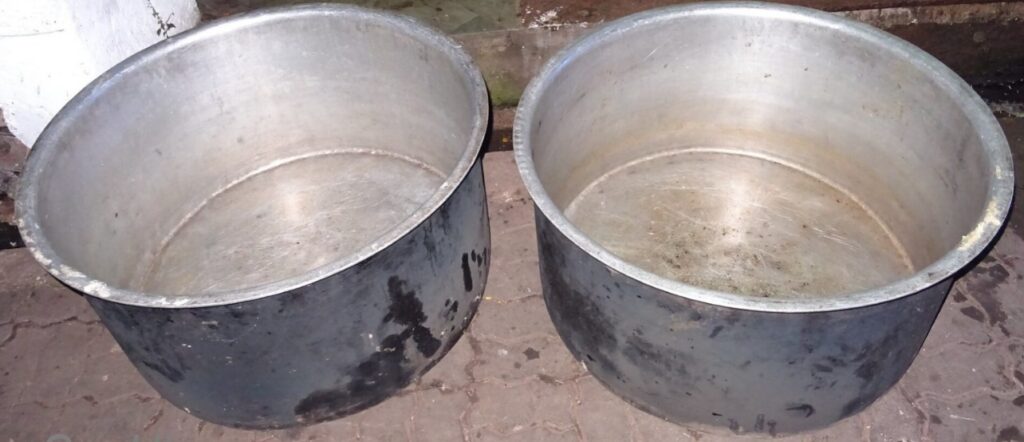
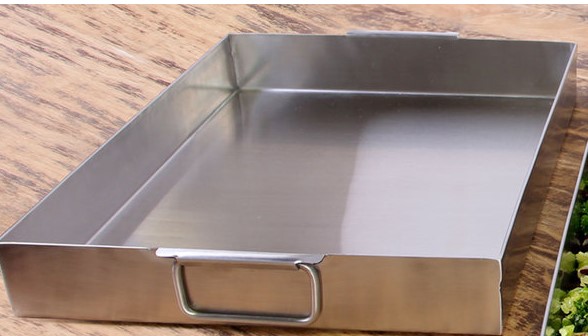

Flies on the food were on an industrial scale because the tables were always filthy!
Another utterly filthy practice was the mid-morning tea. Once again, the tea was ferried from the Senior School in filthy cans (see photo above) and was already cold when it reached. The uniformed bearers who served the tea at the tea counter were dirty and unkempt. They would spill large quantities of that sweetened muck on the counter where it remained until the rain washed it away every now and then. In the photo mentioned in previous paragraphs above, the blue arrow points to where the tea-counter was; it is hidden in the photograph by boys standing on chairs to pose for this photo. What this resulted in were flies; millions of them! Thus in the mornings when standing in formation waiting to get into the dining room, the flies would cause intense irritation to the legs of boys, all of whom wore shorts! A simple cleaning of the counters after each tea break would have obviated the problem but there was simply nobody taking care of such matters.
Junior School Dormitories
In 1958, in my first year at school I was taken to what was described as the Art Classroom. Lo and behold, in 1961 this had been converted into the Himalaya House Dormitory! Whereas the Art Class could just about seat 30 or so pupils the dormitory had to accommodate 50 or so boys, complete with cupboards, beds, a Table Tennis Table and a few toilets. The toilets were simply not sufficient to cater for the needs of a boy being able to defecate every morning so the boys had to adapt; some defecated in the morning, some during the mid-morning tea break, some following lunch and others before or after evening tea. Some even didn’t defecate on a daily basis but once every two or three days! The same set up obtained in the other two houses, Kailas and Shivalik! Alas, as far as Shivalik House was concerned, one had to go past the showers that were used by all the 150 or so boys to get to the toilets!
Senior School Toilets
On to Senior School from Class 8.
Could one expect the situation to improve in Senior School? If one did, one was in for deep, deep disappointment!
Each of the 4 house dormitories had a few toilets, small, stinking and far too close to the beds where the water supply was sporadic. The main toilets where boys from all 4 houses went was called ‘Big Bogs’.
I can do no better than re-append an extract from ‘With A Little Help From My Friends’ a book written by Headmaster Dev Lahiri a quarter of a century after I escaped from the hell-hole:
The infrastructure was in shambles. The school went without electricity for days at a stretch particularly during the monsoons as there was no generator backup. The toilet for the senior boys called ‘Big Bogs’ was my idea of what hell must be like. One visit there was enough to make me want to throw up.
If matters were so bad for the boys, imagine what the teaching and ancillary staff must have been going through. In all the 11 years I was in the school, there was not a single servants toilet. So where did they ‘go’? More than 6 decades later, it is still a mystery to me!
In my house, Nilgiri, We were divided into two dormitories, one for Class 8 and 9 and the other for Class 10 and 11. Really, there should have been 4 dormitories but the two downstairs had been converted; one into art class, and the other divided into a carpentry class and a sculpture class. The downstairs Prefect’s room had been converted into 4 toilet cubicles. There was one tap to serve all 4 with a Bournvita tin to be passed along. The 4 cubicles weren’t enough and most pupils had to make their way to a larger set of toilet cubicles some distance away in what was referred to as Big Bogs. Here, there was a tap in some but not all cubicles. Just one or two Bournvita tins had to be passed around. The method was that as soon as one boy finished shitting, he would wash his bum, get dressed and without washing his hands take the tin he was using, fill it with water from any tap he could find and pass it on to the next boy.
Senior School Dining
In all of my life I have never come across an area that was filthier than the kitchen of the Senior School. On the walls of the kitchen there were thousands of cockroaches just relaxing! No effort whatsoever was ever made to clear them. I am aware that in a country like the UK, the kitchen would have been shut down immediately and the person in charge sacked! Finding dead flies in food was a routine occurrence. If one went into the kitchen, the filth of the cooks would shock anybody! No question of any headgear or apron and obviously, if the boys didn’t have access to soap, the cooks and bearers certainly didn’t!
Bathing (Showering) Facilities at Senior School.
Credit where credit is due. There was a huge boiler, enough to heat the water for the 260 or so boys who had to shower there. There were 20 shower cubicles. There were two problems: 1. showering for the entire Senior School had to be completed in exactly 45 minutes because the time allocated was from 5 pm to 5.45 pm. If everything went like clockwork, this would mean 3.5 minutes per boy. 6 or so prefects ‘hogged’ showers to the exclusion of others so on average, showering was limited to an average of 2 minutes per boy. If a boy was in a queue and time was running out, the boy who went beyond the time of 5.45 was subject to a severe beating!
Dormitories and toiletries at Senior School.
At some stage, a visitor had described Nilgiri House as being the tidiest and cleanest House. This was, of course, utter nonsense as the other dorms were just as tidy and clean. However, Mac the housemaster stuck to that description like a limpet mine and decided that such a reputation must be maintained. After all, it added to his mystique as this ‘almost Englishman’ whose mere being the housemaster resulted in Nilgiri House being the cleanest and tidiest! Thus, Nilgiri House boys such as myself were required to scrub and polish the Nilgiri House floors as often as Mac wished while he slipped out to Ooty. So imagine a sunny Sunday morning when other boys were out playing or just enjoying the lovely sunshine, we were scrubbing the floor with polish and coconut straw (choir). At the time this was happening, the floors were 80 years old and no amount of polishing would hide that simple fact.
Astonishing though it may seem, not everybody has enough toiletries! Thus the ‘borrowing’ of toothpaste, soap, and hair oil was a frequent occurrence. The process was called ‘thriving’. An even more frequent occurrence was the lack of water to even brush teeth! Thus, not brushing was accepted as a matter of course!
Treatment of water.
There came a time in 1965 when somebody decided (never got to know who), that what little water we were getting was unhygienic and needed treatment. A noble thought indeed. However, the manner in which he went about putting matters right would be regarded as comical had not the reality been dangerous and stupid. The corrective measure to be taken was assigned to the school doctor, Dr Braganza. He was not an expert on water treatment and decided that a heavy doze of chlorine applied to the source of supply would put the matter right. A large quantity of chlorine was added to the water and for days on end all the food had a heavy taste of chlorine! What little water there was to brush teeth with was also contaminated with chlorine and obviously the same would apply to the water used to wash bottoms following defecation. In Nilgiri House, there was a fish tank with several fish, all of which perished! I am sure some boys suffered ill effects but who was going to check?
Nearly 6 decades later, I still have nightmares about not having enough water to brush, wash bum following defecation, or even drink!
Conclusion
Pupils recall the wonderful times they had in the school conveniently forgetting the terrible infrastructure. Perhaps I am the only one who has concluded that my parents were paying C O L O S S A L sums of money to send me to what was effectively a fly ridden slum! In the parental house I travelled from, there was a choice between Indian and western toilets, my father owned several apartments with western toilets which he rented out, there was never ever a shortage of water or toilet paper. Anybody who did not wash his hands with soap and water was looked down upon. We travelled to and from Nairobi in modern aircraft, from 1959 in Boeing 707s, prior to that Dakotas, with western toilets. See below the East African batch; I am in there somewhere. To go from that modernity to slum conditions was, in my opinion a gigantic confidence trick played on gullible parents by the school.

Pupils may think going through those difficult times was character building. That would be stupid! Diarrhoea, vomiting and food poisoning were frequent, the food of very poor nutritional value. There is little doubt that this led to stunted growth and life-long illnesses. Almost every single one of my classmates has children/nephews/nieces bigger and stronger than themselves. For instance, my brother Naren, 3 years my senior, in the same school, same house, has three boys, all three of whom are 6 feet 4 inches tall!
See below the letter I had to write to my father requesting an extra egg as there was virtually no protein in the food served to vegetarians. This was the case throughout the 11 years I spent in that institution. The non-vegetarians didn’t fare much better, the only difference being that they were served a bit of goat meat (mistakenly referred to as mutton).

School Van 1937
This van was in use in 1937. When I joined in 1958, it was the same van in use and remained so even after I left in 1968.
