It was Sir Henry Lawrence who ‘founded’ the school, Lawrence School, Lovedale that I attended. However, truth is he didn’t ‘found’ any schools, he founded asylums for the orphans of East India Company and British soldiers. He specified in writing that he only wanted orphans, both of whose parents were Europeans to be admitted. Indians and Anglo-Indians were manifestly excluded and Catholics were only reluctantly accepted. It is also patently obvious that Sir Henry arrived in India as a 17 year old boy not to do good to India but as an economic migrant to earn a living for himself and to support his large family of which he was one of 11 children.
I find it grotesque that Indians in INDEPENDENT India are honouring this scoundrel for founding so called schools from which their ancestors would have been excluded for being Indians. Please see my Page Bogus Military Traditions and watch the celebration of the 167th anniversary of the foundation of the institution. Year by year the celebrations get more and more elaborate, now even with boy lancers escorting the Chief Guest. Such a monstrous celebration of India’s British enemy was not even commemorated during Colonial times!
Sir Henry Lawrence arrived in India in 1823. That was the year Lord Moira left his post as Governor General of India. Well before his arrival, Sir Henry would have been fully aware of what Lord Moira thought about Hindus. I set below his exact words:
“The Hindoo appears a being nearly limited to mere animal functions and even in them indifferent. Their proficiency and skill in the several lines of occupation to which they are restricted, are little more than the dexterity which any animal with similar conformation but with no higher intellect than a dog, an elephant or a monkey, might be supposed to be capable of attaining.” Lord Moira Governor General of India ~1813
As a loyal British Subject, Sir Henry would have gone about his business with Lord Moira’s words inculcated in his head and so began his 34 year career in India.
This page is not is a detailed History of Sir Henry Lawrence, the founder of my ‘school’, Lawrence School Lovedale but parts relevant to my aim which is to bust the myths surrounding him as a great, benevolent soldier statesman who should be honoured by spending countless hours over many years practicing for a parade in his honour. It reality he was little more than a colonial tax extorter employed by East India Company, I will also demonstrate that he was a thoroughly incompetent and unfit ‘soldier’ who led those under his command and himself to certain death.

Statue of Sir Henry Lawrence in St Pauls Cathedral

The statue of Sir Henry Lawrence in St Paul’s Cathedral is totally misleading as it shows him as a kindly, benevolent Roman or Greek Soldier receiving poor children into his care, helped by a kindly lady (based on Lady Honoria Lawrence). Truth is Lawrence was entirely responsible for the military disaster that led to his death.
As was the wont of the British at that time, the military disaster which led to the death of Sir Henry was turned into a heroic act. A mere three years earlier, the disastrous ‘Charge of the Light Brigade’ was turned into a heroic act through a poem of the same name by Tennyson. In the case of the Light Brigade , 469 of 664 soldiers were blown to bits by Russian gunners. In Lawrence’s case, of the 700 men he led into battle, 365 perished and a couple of days later, he too perished due to his own incompetence! The men that Lawrence led into battle at the zenith of an extremely hot day were anyway dehydrated because they had consumed raw spirits the previous night, no water was available even the next day before the expedition commenced and they had not eaten. They were in no fit state to even carry out non-combat duties, let alone go into battle!
Here is how Tennyson turned a military disaster into a fantasy heroic action:
Charge of the Light Brigade by Alfred Lord Tennyson
Half a league, half a league,
Half a league onward,
All in the valley of Death
Rode the six hundred.
“Forward, the Light Brigade!
Charge for the guns!” he said.
Into the valley of Death
Rode the six hundred.
“Forward, the Light Brigade!”
Was there a man dismayed?
Not though the soldier knew
Someone had blundered.
Theirs not to make reply,
Theirs not to reason why,
Theirs but to do and die.
Into the valley of Death
Rode the six hundred.
Cannon to right of them,
Cannon to left of them,
Cannon in front of them
Volleyed and thundered;
Stormed at with shot and shell,
Boldly they rode and well,
Into the jaws of Death,
Into the mouth of hell
Rode the six hundred.
Flashed all their sabres bare,
Flashed as they turned in air
Sabring the gunners there,
Charging an army, while
All the world wondered.
Plunged in the battery-smoke
Right through the line they broke;
Cossack and Russian
Reeled from the sabre stroke
Shattered and sundered.
Then they rode back, but not
Not the six hundred.
Cannon to right of them,
Cannon to left of them,
Cannon behind them
Volleyed and thundered;
Stormed at with shot and shell,
While horse and hero fell.
They that had fought so well
Came through the jaws of Death,
Back from the mouth of hell,
All that was left of them,
Left of six hundred.
When can their glory fade?
O the wild charge they made!
Below is the Royal Insignia appointing Sir Henry as a Knight Commander. Only on being made Knight Commander could he use the honorific ‘Sir’. Note also that the award was for civil, not military service.

The inscription Trla Juncta In Uno translates as three joined in one referring to either Union of England Scotland and Ireland or to the Holy Trinity. Ireland became Independent on 6 December 1921. Lawrence and Honoria were Protestants of Irish origin.
Lawrencians are led to believe that Sir Henry Lawrence was a British General who served the British Crown. He wasn’t! He was an employee of East India Company which had its own forces and ranks. After his death, his employer East India Company’s own Senior Official Charles Raikes, described Lawrence as a mere Bengal civilian! Lawrence was never ever a King’s Commissioned Officer! Sir John Fortescue , eminent Historian of the British Army said ‘In principle Lawrence was no doubt right to take the the offensive but he should have left the business of commanding in the field to his officers.’
Sir Henry’s father was Lt-Colonel Alexander Lawrence who led the storming of Seringapatam in 1799 during which Tipu Sultan was killed.. His mother, Catherine Letitia Knox was from Co Donegal. The family were Protestants originating from Ulster. Lt-Colonel Alexander encouraged Henry who was one of 11 children of Alexander and Letitia to consider a career in the the East India Company rather than the British Army. Thus, In August 1820, Lawrence entered East India Company Military Seminary at Addiscombe, Surrey . On passing out in 1822, he was commissioned as second lieutenant in the Bengal Artillery. He was all of 16 years old.
The image below is the famous Tipu Sultan Tiger devouring a British soldier. Sir Henry’s father Alexander led the storming of Seringapatam during which Tipu Sultan was killed.

Below is Sir Henry’s Petition to join the Addiscombe Military Seminary and Proof of Birth. The requirement to register a birth only came about in 1837. Until then a Parent’s Certificate was acceptable: All Lawrence’s father had to do was certify that there was an entry in Register of Births and Baptisms in Colombo in the island of Ceylon (now Sri Lanka) where Sir Henry was born.


East India Company Military Seminary in Addiscombe, Surrey (see photo below)

Note the motto on the building: ‘ NON FACIAM VITO CULPAVE MINOREM’ TRANSLATED AS I WILL NOT LOWER MYSELF BY VICE OR FAULT.
History and Economics that Lawrence Was Imbued with at Addiscombe Military Seminary
Whilst at Addiscombe, this is the History that would have been taught to Sir Henry: Extract from James Mill 1817: James Mill considered it part of a civilizing mission for Britain to impose its rule on India. Mill saw his own work for the important for the improvement of Indian society. Mill portrayed Indian society as morally degraded and argued that Hindus had never possessed a high state of civilisation.
His best known literary work is his History of British India, in which he describes the acquisition of the Indian Empire by England and later the United Kingdom. In the work, he characterizes Indian society as barbaric and Indians as incapable of self-government. He also brings political theory to bear on the delineation of the Hindu civilization, and subjects the conduct of the actors in the successive stages of the conquest and administration of India to severe criticism. The work itself, and the author’s official connection with India for the last seventeen years of his life, effected a complete change in the whole system of governance in the country. Mill never visited the Indian colony, relying solely on documentary material and archival records in compiling his work.
According to Thomas Trautmann, ( an American historian, cultural anthropologist, and Professor Emeritus of History and Anthropology at the University of Michigan) “James Mill’s highly influential History of British India (1817) – most particularly the long essay ‘Of the Hindus’ comprising ten chapters – is the single most important source of British Indophobia and hostility to Orientalism. In the chapter titled General Reflections in “Of the Hindus”, Mill wrote “under the glossing exterior of the Hindu, lies a general disposition to deceit and perfidy”. According to Mill, “the same insincerity, mendacity, and perfidy; the same indifference to the feelings of others; the same prostitution and venality” were the conspicuous characteristics of both the Hindoos and the Muslims. The Muslims, however, were perfuse, when possessed of wealth, and devoted to pleasure; the Hindoos almost always penurious and ascetic; and “in truth, the Hindoo like the eunuch, excels in the qualities of a slave“. Furthermore, similar to the Chinese, the Hindoos were “dissembling, treacherous, mendacious, to an excess which surpasses even the usual measure of uncultivated society”. Both the Chinese and the Hindoos were “disposed to excessive exaggeration with regard to everything relating to themselves”. Both were “cowardly and unfeeling”. Both were “in the highest degree conceited of themselves, and full of affected contempt for others”. And both were “in physical sense, disgustingly unclean in their persons and houses”
Economics
As well as History of British India by James Mill, Lawrence would have learnt his economics from Malthus the famous (or more accurately infamous) economist employed by the East India Company at their East India Company College as Professor of History and Political Economy. His students nicknamed him ‘Pop’ for his theories on population. He was also a friend of James Mill mentioned above. Malthus’ theory on famine was set out as follows: ‘Famine seems to be the last, most dreadful resource of nature. The power of population is so superior to the power in the Earth to produce subsistence for man, that premature death must in some shape or other visit the human race….’ His idea was that the Government should not interfere if there was a famine and people must be allowed to die!
Author Tharoor has stated that there were numerous famines during British rule including the Great Bengal Famine (1770), Madras (1782–1783), Chalisa Famine (1783–1784) in Delhi and surrounding areas, Doji Bara Famine (1791–1792) around Hyderabad, Agra Famine (1837–1838), Orissa Famine (1866), Bihar Famine (1873–1874), Southern India Famine (1876–1877), Bombay Famine (1905–1906) and the Bengal Famine (1943–1944).
Two of these famines occurred during the alleged ‘glorious past’ period: Page Alleged Glorious Past V Reality 1. when Lord Lytton visited the school in 1877 and 2. in 1917 when Willingdon was Governor of Bombay. Far from giving tax relief to the farmers the dastardly Willingdon INCREASED taxes by 23! It was this same Willingdon who as Governor of Madras in 1921 was part of the presiding committee that presented colours to the school by His Royal Highness The Duke of Connaught and Stathearn, K. G., on Saturday , January 15th, 1921. I have set out details of the 3rd and perhaps the most devastating famine, the Bengal Famine in other Posts within this Blog.
It follows that Lawrence and successive colonials were never going to deal with such catastrophes as famines with a view to providing good governance for the benefit of Indians but rather to use such catastrophes to oppress Indians even more and take advantage of a weakened people, weakened as a result of famines caused by the British in the first place!
Note below how Lawrence followed the classic British policy of Divide and Rule.
“In 1844, while serving as Resident in Nepal, he [Lawrence] wrote the first of a number of anonymous articles for the Calcutta Review that advocated sweeping military reform. Entitled ‘Military Defence and our Indian Empire’, it declared his belief that the British deceived themselves if they thought that their government was “maintained otherwise than by the sword”. It was necessary, therefore, to keep that sword from rusting. Not least because, in his opinion, the greatest threat to British rule “is from our own troops” and the recruitment policy of the Bengal Army was partly to blame. He wrote:
”Our Sepoys come too much from the same parts of the country; Oude, the lower Dooab and upper Behar. There is too much of clanship among them, and the evil should be remedied by enlisting in the Saharunpoor and Delhi districts, in the hill regions, and in the Malay and Burmah States… We would go farther, and would encourage the now despised Eurasians to enter our ranks, either into sepoys corps where one or two here and there would be useful, or as detached companies or corps…”
“In 1856, Sir Henry Lawrence now Agent to the Governor-General in Rajputana – argued against this practice in another essay demanding military reform in the Calcutta Review. He blamed the “Hindoo prejudices of commanding officers” for the fact that “scarcely three thousand” Sikhs had been recruited to the Bengal Native Infantry since the regulations were altered in November 1853. The actual number was probably half as much, Lawrence believed, because “some Sikhs have abjured Sikhism, others have been driven out of it, and not a shadow of encouragement has been given to counteract the quiet, but persistent opposition of the Oude and Behar men”. Such internal opposition “to the introduction of new classes into the army” had even prevented Lieutenant-General Sir Patrick Grant, then a captain, from recruiting “hardy Aheers” and “Ranghurs” into the ranks of the newly-raised Hurriana Light Infantry in the late 1830s. According to Lawrence, who heard it from Grant himself, “the Rajpoots and Brahmins bullied the new levies out of the corps”. Lawrence’s solution had not altered much since 1844. It was both to extend the field of recruitment for the regular army and to have regiments of separate classes.”
(Amiya Sen, The structure and organisation of the Bengal Native Infantry with special reference to problems of discipline (1796 – 1852), May 1961)
The East India Company Military Seminary opened in 1809 and closed in 1861. Its purpose was to train young officers to serve in the East India Company’s private army in India. The Bengal Artillery was one such private army
One distinctive characteristic of India was that military officers of the East India Company were used to fill a number of administrative, judicial and diplomatic posts. They were the ‘politicals’, military officers by title and early training but serving in what were essentially civilian appointments.
The Bengal Army was the army of the Bengal Presidency, one of three such presidencies of British India, the other two being the Madras Presidency and the Bombay Presidency. The East India Company paid for the three armies of these Presidencies from profits the company made. Thus, as at the date of Sir Henry’s death, he was on the payroll of the East India Company.
To quote William Dalrymple, ‘We still talk about the British conquering India, but that disguises a more sinister reality. It was not the British government that seized India at the end of the 18th century but a dangerously unregulated private company headquartered in one small office, five windows wide, in London, and managed in India by an unstable sociopath – Clive’
Clive, who we were taught in our History lessons to refer to as Clive of India was an employee of the East India Company as was, many years later, Sir Henry Lawrence. ‘What honour is left to us when we have to take orders from a handful of traders who have not yet learned to wash their bottoms?’ asked a Mughal official named Narayan Singh shortly after 1765. Lawrence School Lovedale, more than 7 decades after Independence honours an employee of such traders by having a Founder’s day in his honour! Effectively we are honouring a person who hadn’t learnt to wash his bottom!
Below: Marriage Certificate of Henry Lawrence and Honoria Marshall. He was posted to Gorakhpur (now famous for being Yogi Adityanath’s ‘Mutt’) and she was ensconced in Cossipore, a district ‘acquired’ by East India Company from Siraj-Ud-Dawlah.

Lawrence and Tax Extortion
To get a Historical background to Sir Henry’s activities, read the following two History notes:
Note 1. Domesday Book: – is a manuscript record of the “Great Survey” of much of England and parts of Wales completed in 1086 by order of King William I, known as William the Conqueror. The Anglo-Saxon Chronicle states that in 1085 the king sent his agents to survey every shire in England, to list his holdings and dues owed to him. The survey’s main purpose was to record the annual value of every piece of landed property to its lord, and the resources in land, manpower, and livestock from which the value derived.
Note 2: Warren Hastings introduced the office of the District Collector in the Judicial Plan of 1772. By the Judicial Plan of 1774 the office of the Collector was temporarily renamed Diwan. The name, Collector, derived from their being head of the revenue organization (tax collection) for the district.
Whereas the revenue collected in respect of the Domesday Book or Great Survey went to the King, the revenue collected resulting from the Judicial Plan of 1774 went to the East India Company, a joint stock company, of which many years later Lawrence was merely an employee.
In 1833 Lawrence was appointed an assistant to the Revenue Survey of India. The ‘raison d’être’ for the Revenue Survey of India was to exact the maximum tax (which is what ‘revenue’ is) from Indians for the benefit of the shareholders of the East India Company. Here is the quote of the secretary to the Board of Revenue marked for the attention of the Lieutenant Governor of the North-West Provinces:
“Captain Lawrence is one of the most experienced and zealous of the officers employed in the survey, and has conducted the process of double survey more successfully than perhaps any other…Captain Lawrence is prepared to guarantee a complete survey of three thousand square miles per annum when the villages average one square mile each.”
Lawrence remained in this post until 1838. This extract from The Victorian Web quotes Lawrence as saying: “bayonets and red coats” remain essential, and he asks rhetorically, “how could any Government, however beneficent, subsist for a day simply by its civil policy on the ruins of such a tempest-tost land? How in a day convert tribes who have lived only by war to habits of peace; how make cultivators, who for centuries have never paid a rupee, but under fear of the sword or the scourge — how induce them to pay their dues, unless they know that the civil officer has the power of calling in the military : and that the latter is prompt and bold? In other words, Lawrence went about his job of exacting taxes knowing that he had military backing to exact such taxes.
The system of tax extraction which Lawrence followed with minor changes: First laid down by Lord Cornwallis and implemented in 1793. Note: Lord Cornwallis was at constant war with Tipu Sultan and when Tipu was killed in his last stand against the British in 1799, Henry’s father Lt.Col Alexander Lawrence was part of the British Army that stormed Seringapatam. Lord Cornwallis died in 1805 and lies buried in Ghazipur. Henry Lawrence was born in 1806, just a year after Cornwallis’ death but his father Lt.Col Alexander Lawrence outlived Cornwallis by 25 years. So there would have been plenty of time for Henry to be inculcated with knowledge of the Permanent Settlement by his father as well as by Addiscombe Seminary. Henry therefore went into India with his eyes open as to what the purpose of his posting to India was; the collection of exorbitant taxes, if necessary by military means! Is such a person deserving of honour by way of celebrating ‘Founder’s Day’ and singing various songs in his honour?

Note the 89% the Zamindars had to pay the British! Lawrence was part of the system extorting such exorbitant taxes!
Here is the link to the full article. Note in particular the words ‘This system accelerated the drain of wealth from India to Britain’.
Lawrence, among others laid the foundation for the exorbitant extraction of such taxes which remained British policy even after the British Government took over India from the East India Company as evidenced by the following extract relating to Lord Willingdon, set out on another Post (Glorious Past v Reality):
In 1917, the year before Willingdon’s resignation of the governorship, a severe famine broke out in the Kheda region of the Bombay Presidency, which had far reaching effects on the economy and left farmers in no position to pay their taxes. Still, the government insisted that tax not only be paid but also implemented a 23% increase to the levies to take effect that year. Kheda thus became the setting for Gandhi’s first satyagraha in India, and, with support from Sardar Vallabhbhai Patel, Narhari Parikh, Mohanlal Pandya, and Ravishankar Vyas, organised a Gujarat sabha. The people under Gandhi’s influence then rallied together and sent a petition to Willingdon, asking that he cancel the taxes for that year. However, the Cabinet refused and advised the Governor to begin confiscating property by force, leading Gandhi to thereafter employ non-violent resistance to the government, which eventually succeeded and made Gandhi famous throughout India after Willingdon’s departure from the colony. For his actions there, in relation to governance and the war effort, Willingdon was on 3 June 1918 appointed by the King as a Knight Grand Commander of the Order of the Star of India.[11]
Note: In present day India under section 10(1) of the Income Tax Act, 1961, agricultural income is exempted from tax. Any proceeds from rent, revenue or transfer of agricultural land and incomes from farming are considered as agricultural income under the law.
To clarify History further, in 1856, Oudh (what Indians should call Avadh) had been annexed by the East India Company on the grounds of internal maladministration. The following March Lawrence was appointed Chief Commissioner of Oudh. In May 1857, the so called Indian Mutiny (which was never called First War of Independence in the History we were taught) occurred and to cut a long story short, Lawrence was killed in the war that followed the exact date of his death being 4 July 1857.
By passing the Government of India Act 1858, the British Government nationalised the East India Company. The British Government took over East India Company’s Indian possessions, its administrative powers and machinery and its armed forces. But Lawrence had already been killed in 1857. Effectively, we are honouring a deceased employee of a disreputable trading company!
Lawrence, Duleep Singh, Maharani Jind Kaur
Read this extract of how Lawrence treated Maharani Jind Kaur, widow of Rana Ranjit Singh and mother of Duleep Singh who, aged 9 was persuaded to part with the Koh-I-Noor diamond which Lawrence was tasked with taking to England and presenting to Queen Victoria:
‘in August 1847 Duleep Singh refused to invest Tej Singh as Raja of Sialkot, the British Resident, Henry Lawrence, imprisoned the Maharani in the Samman Tower of the Lahore Fort and, ten Whendays later, moved her to the fortress in Sheikhupura and reduced her pension to 48,000 rupees. The bitterest blow to the Maharani was the separation from her 9-year-old son. She wrote to Lawrence imploring him to return Duleep to her. “He has no sister, no brother. He has no uncle, senior or junior. His father he has lost. To whose care has he been entrusted?” She did not see her son again for thirteen and a half years. Imagine the pain a mother would have felt being separated from her 9 year old son, whose father had already died, for thirteen and a half years. Sadly Duleep Singh went on to become one of the most debauched people on Earth. Duleep died an alcoholic in Paris and was buried in a pauper’s grave until the British decided it would be to their colonial advantage if he were brought back to England for a decent and dignified reburial.
Below left is a sketch commissioned by Duleep Singh and in the centre is a subsequent painting Maharani Jind Kaur, widow of Maharaja Ranjit Singh. Within weeks of the painting being completed, the Maharani died in her Kensington home in London. On the right is Jitu with the actual throne of Maharaja Ranjit Singh. Lawrence treated Maharani Jind Kaur in a despicable manner.


Here STRICTLY FOR THE ACADEMICALLY MINDED as there is enough History I have set out without the need to read, is an Observer report dated 7 February 1858 of the memorial service held in London following Sir Henry’s death. Note the presence of Maharaja Duleep Singh whose mother had been treated so cruelly! The same Duleep Singh who aged 9 was ‘persuaded’ to hand over the Koh-I-Noor to Queen Victoria.
A few months before the death of Maharaja Ranjit Singh, Lawrence was posted to Ferozepore . The East India Company would not attack Ranjit Singh’s Kingdom as the Maharaja was too powerful so appeasement was practised. The Company was biding its time.
On 25 November 1838, the two most powerful armies on the Indian subcontinent assembled in a grand review at Ferozepore (Where Henry Lawrence was posted) as Ranjit Singh, the Maharajah of the Punjab brought out the Dal Khalsa to march alongside the sepoy troops of the East India Company and the British troops in India. In 1838, he agreed to a treaty with the British viceroy Lord Auckland to restore Shah Shoja to the Afghan throne in Kabul. In pursuance of this agreement, the British army of the Indus entered Afghanistan from the south, while Ranjit Singh’s troops went through the Khyber Pass and took part in the victory parade in Kabul. At about this time, Ranjit Singh gifted a set of 6 miniatures on ivory to Honoria Lawrence:

After the collapse of the Punjab Kingdom, the ‘grand review’ and all that the treaty signed with Auckland implied was quickly set aside and Lawrence’s treatment of Ranjit Singh’s widow was abominable.
Here are ‘blow ups’ of the miniatures:


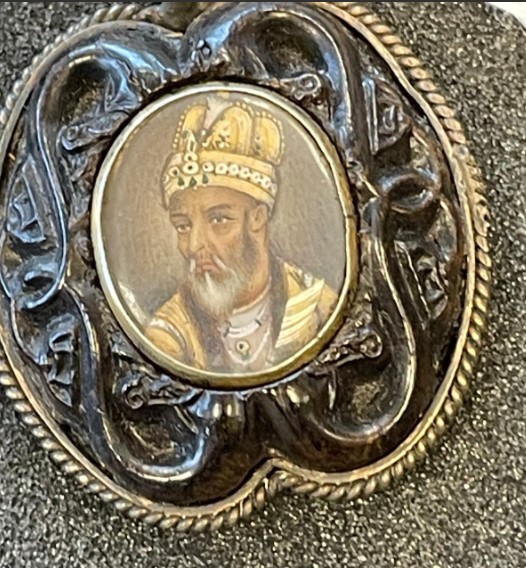


There is nothing that he did for INDIANS that warrants honouring and holding a Founder’s day for him!
 Sir Henry Lawrence


Lawrence’s power over Life and Death: Extract from my Page: Articles of War
Please see the Page mentioned above. This is a small extract:
Power over Life and Death: There are several provisions within these Rules and Articles giving what are ultimately employees of a joint stock company the right to execute other employees of the company. Most ‘soldiers’ in India during Sir Henry’s tenure were in the East India Company Army, more Accurately in the Bengal Presidency Army of East India Company. Lawrence was one such employee. Here is an extract from Page 7:
Any Officer, Non-commissioned Officer, or Soldier, who being present at any Mutiny or Sedition, shall not use his utmost Endeavour to supress the same, or coming to the knowledge of any Mutiny, shall not without delay give information thereof to his commanding officer, shall suffer Death, or such other Punishment, as by a General Court Marshall shall be awarded.
Lawrence and the Koh-I-Noor Diamond
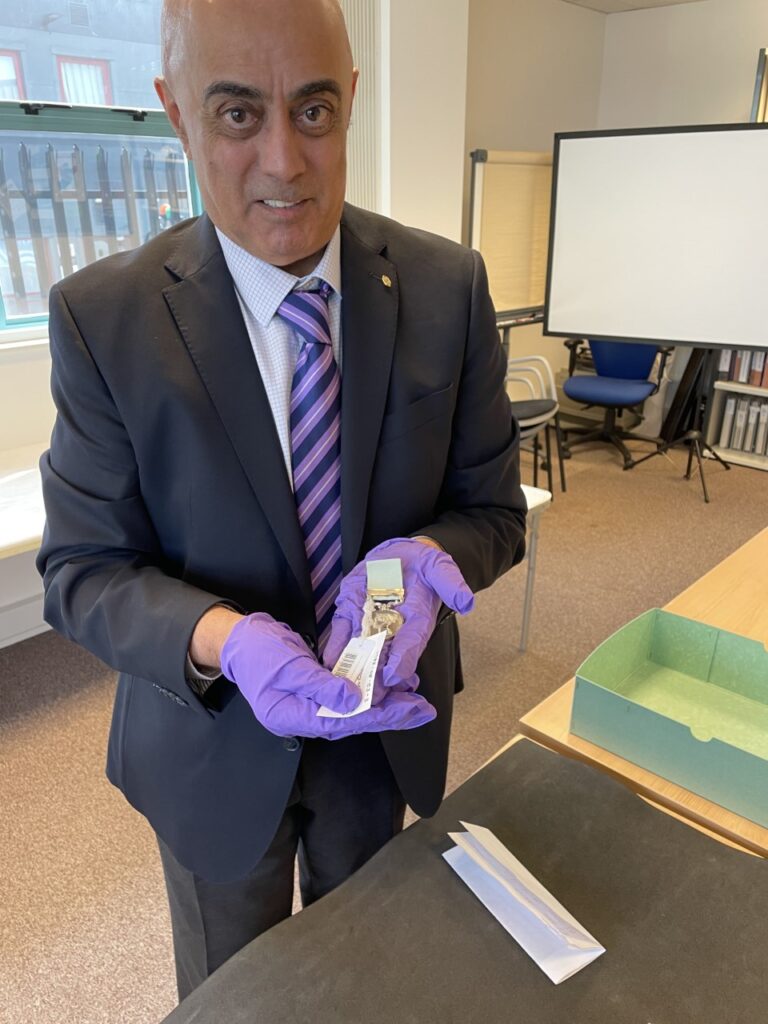
Here is what modern day Sir Henry (see photo) has to say about this matter:
In 1849 my great-great-great grandfather was the official who received the Koh-i-noor diamond from Duleep Singh (Leader, April 27). He informed Queen Victoria, who sent a detachment of soldiers to escort it to the UK. When the soldiers arrived, they asked my ancestor for the diamond. Could he find it? No! He looked everywhere and at last, in despair, asked his Indian servant: “Did you find anything in that coat of mine you sent to the cleaners?” “Nothing,” replied the servant, “only a matchbox containing a lump of glass.”
So the opinion of this direct descendant of the only person in history who ever managed to lose the Koh-i-noor is that it should be returned to India, where it rightfully belongs. And the person who receives it on behalf of the Indian government should be a descendant of the servant who found the matchbox.
Sir Henry Lawrence, Bt (29 April 2002).
Bath Henry.Lawrence@bristol.ac.uk
Below is a photo of Jitu with Sir Henry Peter Lawrence, a direct descendant, author of the statement above

Lawrence’s Hidden History-Part 2

Selected Extracts from Brothers of the Raj
”Nepal was a posting necessitated by his precarious health, but was also a promotion arranged by a governor general solicitous for both his health and career. Rajputana, on the other hand, was, in Henry’s view, a slap in the face by a vengeful superior and a humiliating removal from a post he felt fully qualified to hold. For the remainder of his life, his chief professional aim was to recoup his position in Lahore if possible, or at least to erase in some fashion what he saw as a stain cast upon his reputation by Dalhousie’s dismissal of his services in the Punjab on the grounds of lack of civil qualifications. In Rajputana, he also suffered the loss of Honoria, and his own professional deliverance brought with it the irony of his posting to Luknow on the eve of the bloody uprising of 1857.”
”Even with the pressing nature of his duties in the Punjab, Henry had always found time to raise funds for the Lawrence Asylum in Sanawar. In Rajputana, he could now extend his efforts to the establishment of schools in Mount Abu itself, and in the southern hill station of Ootacamund. In 1854, Henry began raising subscriptions and drafting a scheme for a school for European children in Mount Abu. By November of that year he had purchased two houses, and expected that in March 1855 he would be able to open the school to thirty or forty children. In the event, the school did not really get underway until early 1856, by which time he was also engaged in another scheme for Ootacamund. Henry’s efforts on the latter were made more difficult by objections to the admission of Roman Catholics to the school, an issue both he and John had faced with the first Lawrence Asylum. In 1847, as Henry observed in an unposted letter to the Rev. W. Evans, he had personally sent the first batch of children from Lahore, of whom half were Catholics. The rule was then and continued to be now, that Roman Catholics should be permitted to read the Bible and attend their own chapel. ‘I can see nothing inconsistent with good Protestantism in this’, Henry stated emphatically.”
”After Henry’s death, the fourth and last of the Lawrence Asylums was founded in the Murree Hills above Rawalpindi in 1860. By that time, the Government of India had assumed responsibility for their finances and in 1872 closed its orphanages in Calcutta and Madras in order to remove the children to the Lawrence foundations. The Lawrence Asylums, Dane Kennedy observed, offered an education that stressed ‘discipline, obedience, piety, respectability, and acquiescence to a future of limited opportunity’. The boys wore artillery uniforms, the girls wore plain jackets and white bonnets, and both were divided into military-style companies that marched on parade grounds. They did not have Indian servants. Although Henry had envisioned that the boys would take up trades such as carpentry and smithing, the directors of the schools found this impractical because of native competition. Instead, Kennedy has pointed out, the highest received training in telegraphy, civil engineering and other technical skills, while the rest joined the army or went to work for the railroads. The girls were trained for domestic service, but most of them married non-commissioned officers.”
”My health is better than it used to be,’ Henry wrote to George Clerk in October 1856, ‘but I am getting worn out and cannot stand the heat or exertion as I used to when I had more definite illness.’ His eyes were also failing, he told clerk, and to another correspondent noted that he found it increasingly difficult to deal with ‘heat and bother.’ In fact, his health had deteriorated to the point that three doctors had given him medical certificates recommending that he take a leave. Armed with this unanimity of medical opinion, he applied for and was given permission by the Governor-General to spend several months on leave in England. He planned to leave Rajputana in February, and depart from Bombay in March.”
”However, on 19 January 1857, he received a letter from Lord Canning offering him the post of Chief Commissioner in Oudh, writing as Henry reported to James Outram, that he knew no one to whom he would ‘so gladly and confidently’ trust the province.
He also replied by telegraph on the same day, asking the Superintendent of Electric Telegraph at Indore to forward the following message to the Governor-General, and repeat it ‘so as to prevent any chance of mistake’. The message read as follows: The Doctors say I am in bad health, but that I shall probably be able to work on for (two) years. I am ready to try. I write by today’s post, but shall be glad of a telegraphic reply to this message addressed to Indore.”
”Henry’s attitude toward his new assignment fluctuated between misgivings over his health and excitement at the opportunity vouchsafed him. ‘I have nearly given way more than once,’ he wrote (to) Charlotte, expressing his mixed feelings, ‘but the very offer of the Governor General is a sufficient salve for my Punjab sores.’ In Mount Abu, he had already been in touch with with officials in Lucknow, and his excitement during these weeks may perhaps be judged by a letter to Major Thuillier, written in late February. ‘One of my first official requisitions, ‘ he wrote, ‘will be for surveys, surveys, surveys.”
”As the summary settlement proceeded, Colonel Philip Goldney, Commissioner of Faizabad Division and Gubbins’ staunchest supporter, pursued the policy with draconian zeal, throwing a number of talukdars who could not pay the required sum into prison…
Henry saw the matter differently, of course. Gubbins, he wrote to Canning:
would be continually sending 50 men on elephants forty, fifty and more miles off. He is perfectly insane in what he considers energetic, manly measures. His language has been so extravagant that were he not really useful I should be obliged to take severe measures against him. He is the one malcontent in the garrison.”
”Two or three days earlier, when he was so ill from fatigue and the effects of heat that Dr Fayrer ordered him to stop work, Henry had created a Council of Five …..”
”The following morning, with the sun already high, his troops already tired, and with no food in their stomachs, Henry set off with a force of 300 British soldiers, 320 native infantry, some Sikh cavalry, and nine guns, four of which were manned by native artillerymen. After crossing the bridge at the Kukrail river, a halt was called and Henry went forward to reconnoitre. He had already signalled for a withdrawal when he saw what was a weak advance guard moving towards him. He decided to attack, and found himself engaged with the full rebel force of five and a half thousand of foot, eight hundred horse, and more than a dozen guns. The right wing of the rebel force outflanked the British by moving through an unreconnoitered wood and brought heavy fire to bear on them while the main body pressed their frontal attack.”
”Early in the morning of 2 July, Henry, accompanied by his nephew George, inspected the posts and batteries of the compound, and returned to Henry’s room in an upper story of the Residency at about 8 o’clock. In early June he had asked Inglis to get him a large room or two smaller rooms for himself and several other people in a place ‘in a central position’, where ‘I shall not be very hot’. It was important for him, he wrote ‘to be as cool as possible as I feel the heat greatly’. Whether this was a room supplied by Inglis or not, Henry was surely occupying a billet so exposed to enemy fire in order to catch whatever cooling air might waft over the beleaguered position.
Henry flopped down on his bed without removing his clothes, and George lay down on his bed a few feet away. Lawrtence asked Captain Wilson, who was attending Henry in the room, to write a memorandum on the issuing of rations. As Wilson left, he reminded Henry of his promise to move to a safer room downstairs. Henry told him he wanted to rest a couple of hours before having his belongings moved. Half an hour later Wilson returned, and read out his memorandum as he stood between the beds, with his knee resting on the one occupied by Henry. Henry, Wilson wrote, was in the process of explaining what he wished altered, when the fatal shot came. A sheet of flame, a terrific report, a shock and dense darkness is all that I can describe. I fell down on the floor and perhaps for a few seconds was quite stunned. I then got up, but could see nothing for the smoke or dust. Neither Sir Henry or his nephew made any noise, and in great alarm I called out, ‘Sir Henry, are you hurt?’ Twice I thus called and without any answer, the third time he said in a low tone, ‘I am killed.
Henry suffered greatly in the remaining time before his death. He was given laudanum and chloroform, and, in his last hours, according to Mrs Harris, great amounts of champagne and arrowroot. ‘His screams were so terrible’, she recounted, that I think the sound will never leave my ears.’
Throughout 3 July , he joined in prayers with the chaplain, but spoke out intermittently, asking at least once that the Lawrence Asylum be remembered. At 8 am on the morning of 4 July, he died quietly.”
Lawrence’s Hidden History – Part 3 -Swords and Medals
I am sure Lawrencians have come across soldiers virtually across all countries looking resplendent with various campaign medals pinned on their uniforms. In colonial times, such medals were dished out like confetti, frequently merely for being present at an event. Thus, you will see from my Post Lawrence and the present day Kashmir issue the sheer number of medals given to Hari Singh, the last Maharaja of Kashmir. Hari Singh was a wimp who deserved no medal and those given to him by the British were entirely bogus. Similarly, Sir Henry was no brave, robust frontline soldier. He was a malaria (Arakan Fever) ridden weakling. His own people regarded him as a Bengal civilian. His expertise was in tax extortion and, allegedly, diplomacy. But one can imagine how impressive the medals would have looked on him. The Mutiny Medal would have been given posthumously. Had he lived, it is almost certain he would have been court-marshalled for his incompetence! These are the actual, original medals I was given access to at the National Army Museum in England. As for the swords, these are his actual swords; curved as were swords used in India. With his poor state of health, it is certain that Lawrence would not have been in a position to use them in actual combat.



Lawrence’s Bogus Military Ranking
A system exists in the United Kingdom where the Monarch can honour a civilian by granting him the dignity of a baronetcy. While the system still exists, it is rarely used; the last person so honoured was Denis Thatcher, husband of Margaret Thatcher, a former P.M. of the United Kingdom. This was in February 1991. The granting of such a baronetcy allows the grantee to use the honorific ‘Sir’ and this can be passed down the male line of succession. There is no other benefit and certainly a baronet is regarded as a Civilian, not a nobleman. In India, Article 18 of the Constitution banned the use of such titles as ‘Sir’, ‘Rai’ and ‘Rai Bahadur’.
On 16 July 1858, Queen Victoria decided to grant the dignity of a baronetcy to Alexander Hutchinson Lawrence, an employee of East India Company and eldest son of Sir Henry Lawrence. At the time Sir Henry had been dead more than a year. The manner in which such a grant is made is by the Monarch, in this case Queen Victoria, issuing ‘letters patent’ and this is communicated to the world is through publication in the Gazette.
Here is a copy of the entry from the Gazette dated 16 July 1858.

Once the Gazette entry is made, the grantee, in this case Alexander Hutchinson Lawrence sends a memorial to the Earl Marshall and Hereditary Marshall of England applying for ‘arms and crest’.
Here are the exact words of the memorial of Alexander Hutchinson Lawrence sent on 19 July 1858, a year and 15 days after the death of Sir Henry:

The highest rank referred to in this memorial of his own son to the Earl Marshall is ‘Colonel’ in the service of the East India Company. It follows that even the rank of Brigadier General referred to in some quarters and Major General in other quarters was temporary! In those days, such a rank would have the word ‘Brevet’ preceding it. It follows that Sir Henry was simply not good enough to be given the rank of General of any sort, not even in the East India Company Army!
Please read my post ‘Origin of the motto Never Give In’ for further and better particulars.
Lawrence – Flattery
Below are just two of the manuscripts of poems composed by courtiers and inscribed on silk, handed to Lawrence. The documents are in old Persian which was the language of the Mughal courts. I have seen the originals of both and the translation has been done by Mr Alireza Sedighi of British Library. It is fairly obvious that various courtiers are writing the praises of Lawrence, just to remain on his good side. The system was that these courtiers were given a ‘jagir’ or an area of land which yielded as much tax as they could extract. They didn’t have much to do as the money just rolled in. The East India Company, Lawrence’s employers got a fair chunk of those taxes but had total power over the courtiers who could be gotten rid of or replaced anytime by characters like Lawrence. The courtiers spent most of their time writing what can best be described as rubbish poems. One such courtier was Ghalib, famous even today. This is what Wikipedia says about him:
‘Mirza Beg Asadullah Khan (1797–1869), also known as Mirza Ghalib, was a Mughal Urdu and Persian poet. He was popularly known by the pen names Ghalib and Asad. His honorific was Dabir-ul-Mulk, Najm-ud-Daula. During his lifetime, the already declining Mughal Empire was eclipsed and displaced by the British East India Company rule and finally deposed following the defeat of the Indian Rebellion of 1857; these are described through his work.’
Ghalib was the last ‘poet laurate’ of the last Mughal Emperor Bahadur Shah Zafar who also fancied himself as a poet!
Below are two documents composed by mediocre (more accurately rubbishy) poets and handed to Lawrence:

لارنس صاحب بهادر صاحب تاج و علم
(Lawrence the brave lord, the owner of the crown and flag)
داد رونق خطه کشمیر را ز ابر کرم
(He) prospered Kashmir region with his generosity which is like a cloud/ the prosperity of Kashmir is due to his generosity)
تا گل خورشید بر سر می گذارد آسمان
(Until when the sky puts the sun like a flower on its head: until when the sun comes to the sky)
سرخرو چون لاله بادا تیغ فوجش دمبدم
(I pray that the swords of his army /soldiers will be as red as tulips every moment) so the poet prays his soldiers to kill the enemies until the end of the world!
یک زبان یک قول و یکدل تا ابد در قول و فعل/ این مهاراجه بود با صاحب جاه و حشم
(This Maharajah who has (high) position and servants (is the only person) who does not change his words and does not have doubt (about anything) in his acts forever.)
صبح آسا در ولای صاحب تاج و کلاه / از صفا هر دم مهاراجا بود ثابت قدم
(Due to his (inner) purity like the morning this Maharaja is steadfast every moment in the love of the owner of the crown (king)
عهد و قول کونپنی صاحب بهادر تا ابد / ثابت و صادق بود دائم زند از صدق دم
His promise and words are consistent (not breakable) honest forever (respectively) and always full of truth.
(In the poem the poet uses the word Kunpani = company as an epithet for Lawrence, he says the words and promises of kumpani sahib bahadur = company, brave lord are consistent ….)
Note from Jitu: The courtier for the above was Mirza Lami.

Sadly, the language used in the above document is out of date and the best that Urdu and Persian Historians/translators can come up with is as follows:
In this auspicious time, and with the Recommendation / discretion of Sir Henry Montgomery, the title of (Maharajah) is given to General Gulab Singh due to the history/records of his loyalty and services with ultimate benevolence since the time of the late Maharaja. General Gulab Singh should consider this great gift as the capital of his honour and endeavour to perform the service more than ever before.
Written on 28/29 November 1846
Lawrence – Honours
During his lifetime Lawrence received two Honours, both were as a civilian:
For the first Honour, See below Gazette entry dated 27 June 1846 appointing Brevet Lieutenant Colonel Henry Montgomery Lawrence, Bengal Artillery to be Companion of the Most Honourable Military Order of the Bath. Note: Although, the citation mentions Military Order the Bath, In 1847, Queen Victoria issued new statutes eliminating all references to an exclusively military Order. As well as removing the word ‘Military’ from the full name of the Order, this opened up the grades of Knight Commander and Companion to civil appointments, and the Military and Civil Divisions of the Order were established. The word ‘Brevet’ roughly means temporary. The appointment as Companion of the Most Honourable Military Order of the Bath entitled Henry to use the honorific ‘Sir’.
For the second Honour, see the Gazette dated 20 June 1854. This describes Sir Henry as Colonel Sir Henry Montgomery Lawrence of the Bengal Artillery.


Please see photo of the medal appointing Sir Henry Knight Commander towards the top, just below the poem Charge of the Light Brigade. Note: the medal was for Civil services, not Military Services.
In this day and age, such Honours are meaningless. During British rule, all that an Aide-De-Camp had to do was escort a visiting Royal to any function or Ceremony. During Lawrence’s time, no such Royal ever visited!
In the Indian Constitution Right to Equality (Articles 14 – 18):
The right to equality provides for the equal treatment of everyone before the law, prevents discrimination on various grounds, treats everybody as equals in matters of public employment, and abolishes untouchability, and titles (such as Sir, Rai Bahadur, etc.)
Please also read my Pages